
CSAT (Paper II): previous-year questions
1280 real UPSC Prelims questions (2011–2026) with the official answer and a clear explanation. 400 of them came in the last five papers.
How often UPSC asks this
Questions per year, counted from the official papers.
Subtopics
Arrangements, ranking, ordering and puzzles
142 questions
Clocks and calendars
5 questions
Coding-decoding, series, patterns, cubes, dice and visual reasoning
110 questions
Communication, interpersonal skills and decision-making
10 questions
Counting, permutations, combinations and probability
1 questions
Directions, blood relations and Venn diagrams
60 questions
General English: grammar, vocabulary and comprehension
20 questions
General Hindi: grammar, vocabulary, dialects and comprehension
25 questions
Geometry and mensuration
26 questions
Number system and basic algebra (divisibility, HCF/LCM, remainders, digits, equations)
196 questions
Percentages, profit and loss, discount, simple and compound interest
47 questions
Ratio, proportion, averages, mixtures and alligation
47 questions
Syllogisms, statements and conclusions, assumptions and arguments
89 questions
Time and work; pipes and cisterns
2 questions
Time, speed and distance; trains, boats and streams; races
48 questions
Attempt the questions
Newest papers first. Tap an option; the answer and the reason appear instantly.
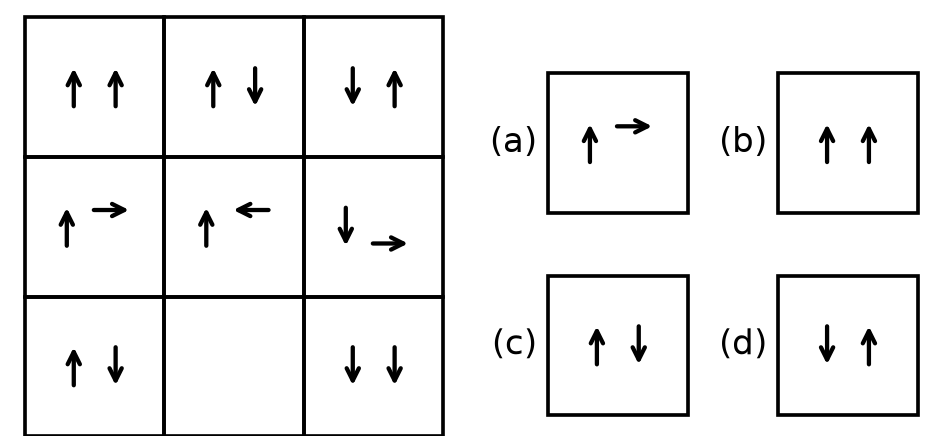
Consider the following matrix :
Which one of the following figures fits into the blank part of the above matrix ?
Answer (b) & explanation
1. Look down each column at the first (left) arrow: column 1 is always ↑, column 2 is always ↑, column 3 is always ↓. So the blank starts with ↑.
2. Look along each row at the second arrow: the middle box is the opposite of the two outer boxes (row 1: ↑ ↓ ↑; row 2: → ← →). Row 3 is ↓ ? ↓, so the middle one is ↑.
3. The blank is ↑ ↑, which is (b).
Answer as per the official UPSC answer key.
Read the passage
Passage - 2
Cynthia was a shy girl. She believed that she was plain and untalented. One day her teacher ordered the entire class to show up for audition for the school play. Cynthia nearly died of fright when she was told that she would have to stand on stage in front of the entire class and deliver dialogues. The mere thought of it made her feel sick. But a remarkable transformation occurred during the audition. A thin, shy girl, her knees quaking, her stomach churning in terror, began to stun everyone with her excellent performance. Her bored classmates suddenly stopped their noisy chat to stare at her slender figure on the stage. At the end of her audition, the entire room erupted in thunderous applause.
Cynthia was afraid to stand on stage because
No official answer (question dropped) & notes
The answer is (c), she lacked self-confidence. UPSC did not evaluate the six English-only items of 2014 (Q70 to Q75), so this answer is for practice. Step 1: find the cause. "Cynthia was a shy girl. She believed that she was plain and untalented." Believing you have no talent is a lack of self-confidence, and that is why she feared the stage. Step 2: test the others. Option (a) is wrong: the passage never says she feared her classmates would laugh. Option (b) is wrong: her churning stomach was a result of her fear, not its cause. Option (d) is wrong: the passage does not say she disliked school plays.
Tip: separate the cause of a feeling from its symptoms. A churning stomach and shaking knees are symptoms; the cause is in what she believed about herself.
UPSC did not evaluate the six English-only items of 2014 (Q70 to Q75), so there is no official key. The answer given in the explanation is for practice.
UPSC dropped this question from evaluation; there is no official answer.
There are 50 students admitted to a nursery class. Some students can speak only English and some can speak only Hindi. 10 students can speak both English and Hindi. If the number of students who can speak English is 21, then how many students can speak Hindi, how many can speak only Hindi and how many can speak only English ?
Answer (d) & explanation
The answer is 39, 29 and 11 (d). Step 1: 21 students speak English, and 10 of them also speak Hindi. So only English = 21 − 10 = 11. Step 2: everyone speaks at least one language. So all students except the "only English" ones speak Hindi: 50 − 11 = 39 Hindi speakers. Step 3: only Hindi = 39 − 10 = 29. Check: 11 + 10 + 29 = 50. Options (a), (b) and (c) fail this check.
Tip: draw two overlapping circles. Put the "both" number in the middle first, then fill the rest. The parts must add up to the total.
Answer as per the official UPSC answer key.
Read the passage
“Liberty, therefore, is never real unless the Government can be called to account when it invades rights.”
Which one of the following is the best justification of the above statement ?
Answer (d) & explanation
Liberty and restraint go together (d). Step 1: read the statement. "Liberty is never real unless the Government can be called to account when it invades rights." So freedom is real only when the power that could crush it is checked. Step 2: that means liberty needs restraints on power; the two are complementary, which is option (d) in UPSC's key. Step 3: test the others. Option (a) is close but names only one mechanism, a court case, not the underlying idea. Option (b) is wrong: singling a person out from other citizens is unrelated. Option (c) is wrong: decentralization and basic needs are not mentioned.
Tip: "best justification" asks for the principle behind a statement, not one example of it.
Answer as per the official UPSC answer key.
Read the passage
It is often forgotten that globalization is not only about policies on international economic relationships and transactions, but has equally to do with domestic policies of a nation. Policy changes necessitated by meeting the internationally set conditions (by WTO etc.) of free trade and investment flows obviously affect domestic producers and investors. But the basic philosophy underlying globalization emphasizes absolute freedom to markets to determine prices and production and distribution patterns, and view government interventions as processes that create distortions and bring in inefficiency. Thus, public enterprises have to be privatized through disinvestments and sales; sectors and activities hitherto reserved for the public sector have to be opened to the private sector. This logic extends to the social services like education and health. Any restrictions on the adjustments in workforce by way of retrenchment of workers should also be removed and exit should be made easier by removing any restrictions on closures. Employment and wages should be governed by free play of market forces, as any measure to regulate them can discourage investment and also create inefficiency in production. Above all, in line with the overall philosophy of reduction in the role of the State, fiscal reforms should be undertaken to have generally low levels of taxation and government expenditure should be kept to the minimum to abide by the principle of fiscal prudence. All these are policy actions on the domestic front and are not directly related to the core items of the globalization agenda, namely free international flow of goods and finance.
According to the passage, under the globalization, government interventions are viewed as processes leading to
Answer (a) & explanation
Interventions are seen as causing distortions and inefficiency (a). Step 1: find the line. Globalization's philosophy views "government interventions as processes that create distortions and bring in inefficiency". Option (a) repeats it. Step 2: test the others. Option (b) is wrong: optimum use of resources is what free markets are said to achieve, not interventions. Option (c) is wrong: profitability of industries is not mentioned. Option (d) is wrong: free play of market forces is the alternative to intervention, the opposite.
Tip: when a question asks how something is "viewed" in a passage, look for the exact verb, here "view", and copy the phrase that follows.
Answer as per the official UPSC answer key.
Read the passage
The number of deaths among the army personnel is 8 in 1000, but among the civilian population it is 20 per 1000.
Which one of the following inferences can be drawn from this statement ?
Answer (d) & explanation
The two groups cannot be compared (d). Step 1: the data show 8 deaths per 1,000 in the army and 20 per 1,000 among civilians. Step 2: think about who is in each group. Soldiers are young, fit and medically screened. Civilians include babies, old people and the sick, who die at higher rates anyway. The groups are heterogeneous (very different), so the lower army death rate does not prove anything about army life. Step 3: test the others. Option (a) is wrong: it treats unlike groups as comparable. Option (b) is too vague. Option (c) is wrong: a Quality of Life index is not shown by death rates alone.
Tip: before comparing two rates, check whether the groups are alike in age and health.
Answer as per the official UPSC answer key.
Consider that :
- 1. A is taller than B.
- 2. C is taller than A.
- 3. D is taller than C.
- 4. E is the tallest of all.
If they are made to sit in the above order of their height, who will occupy the mid position ?
Answer (c) & explanation
C sits in the middle (c). Step 1: write the order from the clues. A is taller than B, so A > B. C is taller than A, so C > A. D is taller than C, so D > C. E is the tallest of all. Step 2: full order from tallest to shortest: E, D, C, A, B. Step 3: five people means the middle seat is the 3rd. Counting from either end, the 3rd is C. Options (a), (b) and (d) are 4th, 5th and 2nd.
Tip: chain the comparisons into one line first. With an odd number of people, the middle is (n + 1) ÷ 2, here (5 + 1) ÷ 2 = 3.
Answer as per the official UPSC answer key.
The following table gives population and total income of a city for four years :
| Year | 1992 | 1993 | 1994 | 1995 |
|---|---|---|---|---|
| Population in lakhs | 20 | 21 | 22 | 23 |
| Income in crores (₹) | 1010 | 1111 | 1225 | 1345 |
Which one of the following statements is correct in respect of the above data ?
Answer (c) & explanation
Per capita income was always above ₹5,000 (c). Step 1: income is in crores and population in lakhs. ₹1 crore ÷ 1 lakh people = ₹100 per person. So per capita income = (income ÷ population) × 100. Step 2: 1992: 1,010 ÷ 20 × 100 = ₹5,050. 1993: about ₹5,290. 1994: about ₹5,570. 1995: about ₹5,850. All are above ₹5,000, so (c) is right. Step 3: option (d) is wrong: the highest is 1995. Option (a) is wrong: population rising from 22 to 23 is under 5%. Option (b) is wrong: income rising from 1,225 to 1,345 is under 10%.
Tip: sort out units (crore, lakh) first. Then test the quickest option to check.
Answer as per the official UPSC answer key.
Read the passage
Passage - 2
Cynthia was a shy girl. She believed that she was plain and untalented. One day her teacher ordered the entire class to show up for audition for the school play. Cynthia nearly died of fright when she was told that she would have to stand on stage in front of the entire class and deliver dialogues. The mere thought of it made her feel sick. But a remarkable transformation occurred during the audition. A thin, shy girl, her knees quaking, her stomach churning in terror, began to stun everyone with her excellent performance. Her bored classmates suddenly stopped their noisy chat to stare at her slender figure on the stage. At the end of her audition, the entire room erupted in thunderous applause.
Cynthia's classmates were chatting because
No official answer (question dropped) & notes
The answer is (b), they were bored. UPSC did not evaluate the six English-only items of 2014 (Q70 to Q75), so this answer is for practice. Step 1: find the phrase. The passage calls them "her bored classmates", who "suddenly stopped their noisy chat" when Cynthia performed. So they were chatting because they were bored of the auditions. Step 2: test the others. Option (a) is wrong: nothing says it was their turn next. Option (c) is the opposite: Cynthia acted so well that they stopped chatting. Option (d) is wrong: the teacher's control is not mentioned.
Tip: an adjective placed right before a noun, like "bored classmates", often answers a "why" question directly. Watch for options that reverse what happened.
UPSC did not evaluate the six English-only items of 2014 (Q70 to Q75), so there is no official key. The answer given in the explanation is for practice.
UPSC dropped this question from evaluation; there is no official answer.
A gardener increased the area of his rectangular garden by increasing its length by 40% and decreasing its width by 20%. The area of the new garden
Answer (b) & explanation
The area increases by 12% (b). Step 1: take the old garden as length 10 and width 10, so area = 100. Step 2: the length goes up 40%, to 14. The width goes down 20%, to 8. Step 3: new area = 14 × 8 = 112. That is 12 more than 100, a 12% increase. Option (a) is the trap: simply doing 40 − 20 = 20% ignores how the two changes multiply. Options (c) and (d) are also wrong.
Tip: quick formula for two percentage changes: a + b + (a × b ÷ 100). Here 40 + (−20) + (40 × −20 ÷ 100) = 40 − 20 − 8 = 12%.
40 – 20 = 20% adds percentages that should be multiplied.
Answer as per the official UPSC answer key.
Read the passage
Many nations now place their faith in capitalism and governments choose it as the strategy to create wealth for their people. The spectacular economic growth seen in Brazil, China and India after the liberalisation of their economies is proof of its enormous potential and success. However, the global banking crisis and the economic recession have left many bewildered. The debates tend to focus on free market operations and forces, their efficiency and their ability for self correction. Issues of justice, integrity and honesty are rarely elaborated to highlight the failure of the global banking system. The apologists of the system continue to justify the success of capitalism and argue that the recent crisis was a blip. Their arguments betray an ideological bias with the assumptions that an unregulated market is fair and competent, and that the exercise of private greed will be in the larger public interest.
Few recognize the bidirectional relationship between capitalism and greed; that each reinforces the other. Surely, a more honest conceptualisation of the conflicts of interest among the rich and powerful players who have benefited from the system, their biases and ideology is needed; the focus on the wealth creation should also highlight the resultant gross inequity.
The apologists of the “Free Market System”, according to the passage, believe in
Answer (c) & explanation
They believe in the market's ability to self-correct (c). Step 1: find the apologists. They "continue to justify the success of capitalism and argue that the recent crisis was a blip". The debates focus on the market's "ability for self correction". Calling the crisis a blip means they trust the market to fix itself. Step 2: test the others. Option (a) is close, but the passage stresses self-correction, not just the absence of control. Option (b) is wrong: protection by government is not discussed. Option (d) is wrong: free goods means goods that cost nothing, which is unrelated.
Tip: a "blip" is a short, temporary problem. Words like this reveal what a group believes.
Answer as per the official UPSC answer key.
Read the passage
It is often forgotten that globalization is not only about policies on international economic relationships and transactions, but has equally to do with domestic policies of a nation. Policy changes necessitated by meeting the internationally set conditions (by WTO etc.) of free trade and investment flows obviously affect domestic producers and investors. But the basic philosophy underlying globalization emphasizes absolute freedom to markets to determine prices and production and distribution patterns, and view government interventions as processes that create distortions and bring in inefficiency. Thus, public enterprises have to be privatized through disinvestments and sales; sectors and activities hitherto reserved for the public sector have to be opened to the private sector. This logic extends to the social services like education and health. Any restrictions on the adjustments in workforce by way of retrenchment of workers should also be removed and exit should be made easier by removing any restrictions on closures. Employment and wages should be governed by free play of market forces, as any measure to regulate them can discourage investment and also create inefficiency in production. Above all, in line with the overall philosophy of reduction in the role of the State, fiscal reforms should be undertaken to have generally low levels of taxation and government expenditure should be kept to the minimum to abide by the principle of fiscal prudence. All these are policy actions on the domestic front and are not directly related to the core items of the globalization agenda, namely free international flow of goods and finance.
According to the passage, the basic philosophy of globalization is to
Answer (c) & explanation
The basic philosophy is absolute freedom for markets (c). Step 1: find the sentence. The philosophy "emphasizes absolute freedom to markets to determine prices and production and distribution patterns". Later, employment and wages are also left to "free play of market forces". So (c) fits. Step 2: test the others. Options (a) and (b) are wrong: they give freedom to producers, not markets; a producer is one player, a market is the whole system. Option (d) is wrong: import and export freedom is the international part, and the passage stresses that globalization is equally about domestic policy.
Tip: one changed word, here "producers" in place of "markets", is a classic UPSC trap. Compare the subject of each option with the passage.
Answer as per the official UPSC answer key.
Read the passage
Given the statement : “Buses are the cause of more accidents than cars, and trucks cause fewer accidents than buses”
Which of the following conclusions can we draw ?
Answer (d) & explanation
No conclusion can be drawn (d). Step 1: the statement only says buses cause more accidents than cars, and trucks fewer than buses. Step 2: test option (a). Accident counts tell us nothing about how many buses and trucks there are on the road, so it fails. Step 3: test (b) and (c). More accidents could be due to more vehicles, longer hours or busier routes, not driver care or skill. Both fail. So none of the conclusions follows.
Tip: raw counts without the base number (how many vehicles, how many kilometres driven) cannot show which group is safer. This idea, comparing rates and not totals, appears often in CSAT logic questions.
Answer as per the official UPSC answer key.
Consider the following statements :
There are six villages A, B, C, D, E and F.
F is 1 km to the west of D.
B is 1 km to the east of E.
A is 2 km to the north of E.
C is 1 km to the east of A.
D is 1 km to the south of A.
Which three villages are in a line ?
Answer (b) & explanation
A, D and E are in a line (b). Step 1: place the villages on a simple grid. Put E at (0, 0). B is 1 km east of E, so B is at (1, 0). A is 2 km north of E, so A is at (0, 2). C is 1 km east of A, so C is at (1, 2). D is 1 km south of A, so D is at (0, 1). F is 1 km west of D, so F is at (−1, 1). Step 2: A, D and E all have the same first number, 0, so they lie on one north–south line. Step 3: check the others. A, C, B form an L shape. C, B, F and E, B, D do not line up.
Tip: draw a quick sketch with one village at the centre. Direction puzzles become easy on paper.
Answer as per the official UPSC answer key.
Consider the table given below in which the numbers bear certain relationship among themselves along the rows :
| 29 | 13 | 18 |
|---|---|---|
| 33 | X | 19 |
| 30 | 27 | 3 |
Which one of the following numbers is the missing number indicated above by X ?
Answer (b) & explanation
UPSC's final key accepts both 15 (b) and 8 (d). Step 1: look for a rule in the complete rows. Row 1: 29 + 13 + 18 = 60. Row 3: 30 + 27 + 3 = 60. So each row adds up to 60. Step 2: apply it to row 2: 33 + X + 19 = 60. So X = 60 − 52 = 8, option (d). Step 3: the table can also be read with a different rule that gives 15, option (b). Because the pattern is not unique, UPSC accepted both answers. Options (a) and (c) fit no rule.
Tip: in number tables, try the simplest rules first: sum of the row, then difference, then product. Check the rule on two full rows before using it.
The rule is not unique, so UPSC's final key accepts both (b) 15 and (d) 8.
Answer as per the official UPSC answer key.
Read the passage
Passage - 2
Cynthia was a shy girl. She believed that she was plain and untalented. One day her teacher ordered the entire class to show up for audition for the school play. Cynthia nearly died of fright when she was told that she would have to stand on stage in front of the entire class and deliver dialogues. The mere thought of it made her feel sick. But a remarkable transformation occurred during the audition. A thin, shy girl, her knees quaking, her stomach churning in terror, began to stun everyone with her excellent performance. Her bored classmates suddenly stopped their noisy chat to stare at her slender figure on the stage. At the end of her audition, the entire room erupted in thunderous applause.
Cynthia's knees were quaking because
No official answer (question dropped) & notes
The answer is (a), she was nervous and shy. UPSC did not evaluate the six English-only items of 2014 (Q70 to Q75), so this answer is for practice. Step 1: find the line. "A thin, shy girl, her knees quaking, her stomach churning in terror." Her knees shook because she was frightened and shy, that is, nervous. Step 2: test the others. Option (b) is wrong: no scolding by the teacher is mentioned. Option (c) is wrong: she was thin, but being thin does not make knees shake; fear does. Option (d) is wrong: she feared the stage, not her classmates.
Tip: the passage gives many details in one sentence. Pick the detail that actually explains the action asked about. Here "terror" and "shy" explain the quaking knees, while "thin" just describes her.
UPSC did not evaluate the six English-only items of 2014 (Q70 to Q75), so there is no official key. The answer given in the explanation is for practice.
UPSC dropped this question from evaluation; there is no official answer.
Six books are labelled A, B, C, D, E and F and are placed side by side. Books B, C, E and F have green covers while others have yellow covers. Books A, B and D are new while the rest are old volumes. Books A, B and C are law reports while the rest are medical extracts. Which two books are old medical extracts and have green covers ?
Answer (b) & explanation
E and F are old, medical and green (b). Step 1: make three lists. Green covers: B, C, E, F. Old books (not new): C, E, F. Medical extracts (not law reports): D, E, F. Step 2: find the books in all three lists. C is green and old but a law report. D is medical but yellow and new. Only E and F are in all three. Options (a), (c) and (d) include B or C, which are law reports.
Tip: when items have several features, write one short list per feature and look for the common members. This avoids mixing up "the rest" in each clue.
Answer as per the official UPSC answer key.
Read the passage
Many nations now place their faith in capitalism and governments choose it as the strategy to create wealth for their people. The spectacular economic growth seen in Brazil, China and India after the liberalisation of their economies is proof of its enormous potential and success. However, the global banking crisis and the economic recession have left many bewildered. The debates tend to focus on free market operations and forces, their efficiency and their ability for self correction. Issues of justice, integrity and honesty are rarely elaborated to highlight the failure of the global banking system. The apologists of the system continue to justify the success of capitalism and argue that the recent crisis was a blip. Their arguments betray an ideological bias with the assumptions that an unregulated market is fair and competent, and that the exercise of private greed will be in the larger public interest.
Few recognize the bidirectional relationship between capitalism and greed; that each reinforces the other. Surely, a more honest conceptualisation of the conflicts of interest among the rich and powerful players who have benefited from the system, their biases and ideology is needed; the focus on the wealth creation should also highlight the resultant gross inequity.
With reference to “ideological bias”, the passage implies that
Answer (c) & explanation
The bias assumes the free market is fair and competent (c). Step 1: find the phrase. The apologists' arguments "betray an ideological bias with the assumptions that an unregulated market is fair and competent". Option (c) repeats this. Step 2: test the others. Options (a) and (b) are wrong: each keeps only one of the two qualities. Option (d) is wrong: "neither fair nor biased" is not what the passage says at all.
Tip: when a question quotes a phrase in inverted commas, like "ideological bias", go straight to that phrase in the passage. The answer is usually in the same sentence. Look for options that keep all the parts, here both "fair" and "competent".
Answer as per the official UPSC answer key.
Read the passage
It is often forgotten that globalization is not only about policies on international economic relationships and transactions, but has equally to do with domestic policies of a nation. Policy changes necessitated by meeting the internationally set conditions (by WTO etc.) of free trade and investment flows obviously affect domestic producers and investors. But the basic philosophy underlying globalization emphasizes absolute freedom to markets to determine prices and production and distribution patterns, and view government interventions as processes that create distortions and bring in inefficiency. Thus, public enterprises have to be privatized through disinvestments and sales; sectors and activities hitherto reserved for the public sector have to be opened to the private sector. This logic extends to the social services like education and health. Any restrictions on the adjustments in workforce by way of retrenchment of workers should also be removed and exit should be made easier by removing any restrictions on closures. Employment and wages should be governed by free play of market forces, as any measure to regulate them can discourage investment and also create inefficiency in production. Above all, in line with the overall philosophy of reduction in the role of the State, fiscal reforms should be undertaken to have generally low levels of taxation and government expenditure should be kept to the minimum to abide by the principle of fiscal prudence. All these are policy actions on the domestic front and are not directly related to the core items of the globalization agenda, namely free international flow of goods and finance.
According to the passage, which of the following is/are necessary for ensuring globalization ?
- 1. Privatization of public enterprises
- 2. Expansionary policy of public expenditure
- 3. Free play of market forces to determine wages and employment
- 4. Privatization of social services like education and health
Select the correct answer using the code given below :
Answer (c) & explanation
Privatization, market-set wages and private social services are needed (c). Step 1: list what the passage requires. Public enterprises "have to be privatized" (item 1). "Employment and wages should be governed by free play of market forces" (item 3). The same logic "extends to the social services like education and health" (item 4). Step 2: test item 2. It is wrong: the passage says government expenditure "should be kept to the minimum", so an expansionary spending policy is the opposite. Options (a), (b) and (d) fail.
Tip: tick items one by one against the text. One item that reverses the passage, like "expansionary" against "minimum", knocks out every option containing it.
Answer as per the official UPSC answer key.
Read the passage
“If political leadership fails to emerge, there is likelihood of military taking over power in developing countries. Radical student groups or labour may try to raise revolution but they are not likely to compete with the military. Military intervention, rule, and withdrawal from politics is closely related to a society’s level of political development.”
In the context of political development, the assumption in the above passage is that
Answer (b) & explanation
The assumption is that the military fills a political vacuum (b). Step 1: read the first line. "If political leadership fails to emerge, there is likelihood of military taking over power." So when there is a vacuum of leadership, the military steps in. Step 2: test the others. Option (a) is wrong: the passage does not say political leadership is ineffective; it talks about it failing to emerge. Option (c) is wrong: the passage says "likelihood", not that military rule is inevitable or needed for development. Option (d) is wrong because (b) fits.
Tip: "likelihood" is not "inevitable". UPSC often offers an option that turns a possibility into a certainty.
Answer as per the official UPSC answer key.