
CSAT (Paper II): previous-year questions
1280 real UPSC Prelims questions (2011–2026) with the official answer and a clear explanation. 400 of them came in the last five papers.
How often UPSC asks this
Questions per year, counted from the official papers.
Subtopics
Arrangements, ranking, ordering and puzzles
142 questions
Clocks and calendars
5 questions
Coding-decoding, series, patterns, cubes, dice and visual reasoning
110 questions
Communication, interpersonal skills and decision-making
10 questions
Counting, permutations, combinations and probability
1 questions
Directions, blood relations and Venn diagrams
60 questions
General English: grammar, vocabulary and comprehension
20 questions
General Hindi: grammar, vocabulary, dialects and comprehension
25 questions
Geometry and mensuration
26 questions
Number system and basic algebra (divisibility, HCF/LCM, remainders, digits, equations)
196 questions
Percentages, profit and loss, discount, simple and compound interest
47 questions
Ratio, proportion, averages, mixtures and alligation
47 questions
Syllogisms, statements and conclusions, assumptions and arguments
89 questions
Time and work; pipes and cisterns
2 questions
Time, speed and distance; trains, boats and streams; races
48 questions
Attempt the questions
Newest papers first. Tap an option; the answer and the reason appear instantly.
Four children are sitting in a row. A is occupying the seat next to B but not next to C. If C is not sitting next to D, who is/are occupying seat/seats adjacent to D ?
Answer (b) & explanation
Only A sits next to D (b). Step 1: four children sit in a row. C is next to neither A nor D, so C can only sit next to B. That means C must be at an end, with B beside it. Step 2: A sits next to B but not C, so A comes next: C, B, A, D (or the reverse, D, A, B, C). Step 3: in both cases D is at the other end, and its only neighbour is A. Option (a) is wrong: B is two seats away from D. Option (c) is wrong: D has only one neighbour. Option (d) is wrong: the answer is fixed.
Tip: find the person with the most restrictions first. Here C can sit beside only one person, which forces the whole row.
Answer as per the official UPSC answer key.
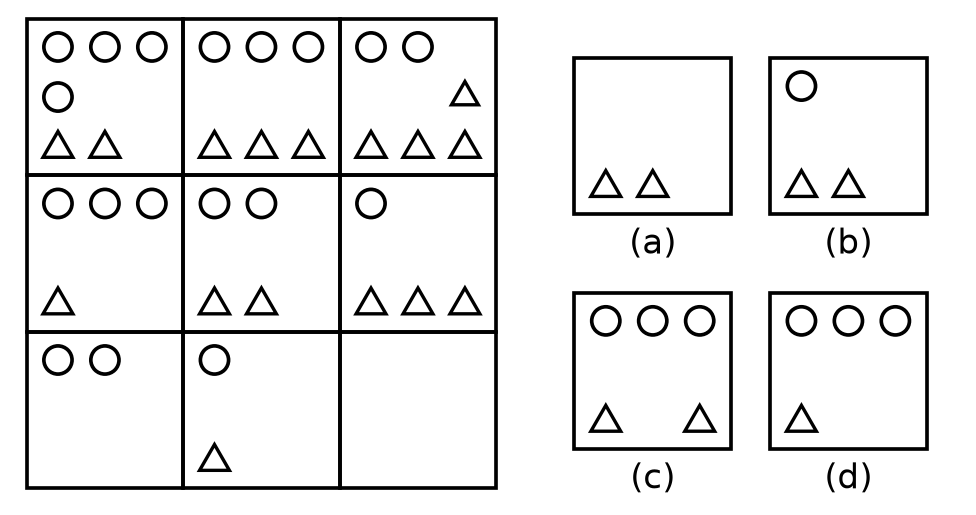
Consider the following matrix with one empty block in the lower extreme corner :
Which of the following figures could fit in the empty block and thus complete the matrix ?
Answer (a) & explanation
Figure (a) completes the matrix (a). Step 1: count the shapes in each box, left to right. Row 1: circles 4, 3, 2; triangles 2, 3, 4. Row 2: circles 3, 2, 1; triangles 1, 2, 3. Step 2: find the rule. Each step to the right, one circle goes and one triangle comes. Step 3: apply it to row 3. Circles go 2, 1, so next is 0. Triangles go 0, 1, so next is 2. The empty box needs two triangles and no circle, which is figure (a). Options (b), (c) and (d) have the wrong counts.
Tip: in figure matrices, count each kind of shape separately; a simple plus-one, minus-one rule is very common.
Answer as per the official UPSC answer key.
Read the passage
Passage - 2
Cynthia was a shy girl. She believed that she was plain and untalented. One day her teacher ordered the entire class to show up for audition for the school play. Cynthia nearly died of fright when she was told that she would have to stand on stage in front of the entire class and deliver dialogues. The mere thought of it made her feel sick. But a remarkable transformation occurred during the audition. A thin, shy girl, her knees quaking, her stomach churning in terror, began to stun everyone with her excellent performance. Her bored classmates suddenly stopped their noisy chat to stare at her slender figure on the stage. At the end of her audition, the entire room erupted in thunderous applause.
The transformation that occurred during the audition refers to
No official answer (question dropped) & notes
The answer is (d), her stunning performance. UPSC did not evaluate the six English-only items of 2014 (Q70 to Q75), so this answer is for practice. Step 1: find the transformation. "But a remarkable transformation occurred during the audition. A thin, shy girl... began to stun everyone with her excellent performance." The change is from a frightened, shy girl to a confident performer. Step 2: test the others. Option (a) is wrong: her nervousness is what she started with, not the change. Options (b) and (c) are wrong: the applause and the classmates' surprise were reactions to the change, not the change itself.
Tip: a "transformation" is a change in the main character. Look for the sentence that comes right after the word, which usually describes it.
UPSC did not evaluate the six English-only items of 2014 (Q70 to Q75), so there is no official key. The answer given in the explanation is for practice.
UPSC dropped this question from evaluation; there is no official answer.
A straight line segment is 36 cm long. Points are to be marked on the line from both the end points. From each end, the first point is at a distance of 1 cm from the end, the second point is at a distance of 2 cm from the first point and the third point is at a distance of 3 cm from the second point and so on. If the points on the ends are not counted and the common points are counted as one, what is the number of points?
Answer (b) & explanation
There are 12 points (b). Step 1: from the left end, gaps are 1, 2, 3, 4 and so on. Points fall at running totals: 1, 3, 6, 10, 15, 21, 28. The next total would be 36, the far end, which is not counted. That is 7 points. Step 2: from the right end, measured from the left, points fall at 36 − 1 = 35, then 33, 30, 26, 21, 15, 8. Another 7 points. Step 3: the points at 15 and 21 appear in both lists, so count them once. Total = 7 + 7 − 2 = 12. Options (a), (c) and (d) do not match.
Tip: convert both sets into distances from one end so that shared points are easy to spot.
Answer as per the official UPSC answer key.
Read the passage
Many nations now place their faith in capitalism and governments choose it as the strategy to create wealth for their people. The spectacular economic growth seen in Brazil, China and India after the liberalisation of their economies is proof of its enormous potential and success. However, the global banking crisis and the economic recession have left many bewildered. The debates tend to focus on free market operations and forces, their efficiency and their ability for self correction. Issues of justice, integrity and honesty are rarely elaborated to highlight the failure of the global banking system. The apologists of the system continue to justify the success of capitalism and argue that the recent crisis was a blip. Their arguments betray an ideological bias with the assumptions that an unregulated market is fair and competent, and that the exercise of private greed will be in the larger public interest.
Few recognize the bidirectional relationship between capitalism and greed; that each reinforces the other. Surely, a more honest conceptualisation of the conflicts of interest among the rich and powerful players who have benefited from the system, their biases and ideology is needed; the focus on the wealth creation should also highlight the resultant gross inequity.
“The exercise of private greed will be in the larger public interest” from the passage
- 1. refers to the false ideology of capitalism.
- 2. underlies the righteous claims of the free market.
- 3. shows the benevolent face of capitalism.
- 4. ignores resultant gross inequity.
Which of the statements given above is/are correct ?
Answer (c) & explanation
Statements 1 and 4 are correct (c). Step 1: the line "private greed will be in the larger public interest" is one of the assumptions the author calls an "ideological bias". So he sees it as a false ideology (statement 1). Step 2: he also wants the focus on wealth creation to "highlight the resultant gross inequity", which the claim ignores (statement 4). Step 3: test the others. Statement 2 is wrong: the author does not see the free market's claims as righteous. Statement 3 is wrong: he does not see greed as capitalism's benevolent face. Options (a), (b) and (d) fail.
Tip: first decide whether the author agrees or disagrees with the quoted line. Here he disagrees, so positive words like "righteous" and "benevolent" are wrong.
Answer as per the official UPSC answer key.
Read the passage
In recent times, India has grown fast not only compared to its own past but also in comparison with other nations. But there cannot be any room for complacency because it is possible for the Indian economy to develop even faster and also to spread the benefits of this growth more widely than has been done thus far. Before going into details of the kinds of micro-structural changes that we need to conceptualize and then proceed to implement, it is worthwhile elaborating on the idea of inclusive growth that constitutes the defining concept behind this Government’s various economic policies and decisions. A nation interested in inclusive growth views the same growth differently depending on whether the gains of the growth are heaped primarily on a small segment or shared widely by the population. The latter is cause for celebration but not the former. In other words, growth must not be treated as an end in itself but as an instrument for spreading prosperity to all. India’s own past experience and the experience of other nations suggests that growth is necessary for eradicating poverty but it is not a sufficient condition. In other words, policies for promoting growth need to be complemented with policies to ensure that more and more people join in the growth process and, further, that there are mechanisms in place to redistribute some of the gains to those who are unable to partake in the market process and, hence, get left behind.
A simple way of giving this idea of inclusive growth a sharper form is to measure a nation’s progress in terms of the progress of its poorest segment, for instance the bottom 20 per cent of the population. One could measure the per capita income of the bottom quintile of the population and also calculate the growth rate of income; and evaluate our economic success in terms of these measures that pertain to the poorest segment. This approach is attractive because it does not ignore growth like some of the older heterodox criteria did. It simply looks at the growth of income of the poorest sections of the population. It also ensures that those who are outside of the bottom quintile do not get ignored. If that were done, then those people would in all likelihood drop down into the bottom quintile and so would automatically become a direct target of our policies. Hence the criterion being suggested here is a statistical summing up of the idea of inclusive growth, which, in turn, leads to two corollaries : to wish that India must strive to achieve high growth and that we must work to ensure that the weakest segments benefit from the growth.
The author’s central focus is on
Answer (c) & explanation
The central focus is inclusive growth (c). Step 1: find the key phrase. The author calls inclusive growth "the defining concept" behind policy, and says growth should be judged by whether its gains are "shared widely by the population". Step 2: test the other options. Option (a) is wrong: India's fast growth is mentioned only in the opening line, and the author then says there is "no room for complacency". Option (b) is wrong: the passage says growth is "not a sufficient condition", so it cannot be the "sole determinant". Option (d) is wrong: high growth is only half the idea; the other half is spreading its benefits.
Tip: the central focus is usually the idea the author defines and keeps returning to, not the first fact mentioned.
Answer as per the official UPSC answer key.
Read the passage
It is often forgotten that globalization is not only about policies on international economic relationships and transactions, but has equally to do with domestic policies of a nation. Policy changes necessitated by meeting the internationally set conditions (by WTO etc.) of free trade and investment flows obviously affect domestic producers and investors. But the basic philosophy underlying globalization emphasizes absolute freedom to markets to determine prices and production and distribution patterns, and view government interventions as processes that create distortions and bring in inefficiency. Thus, public enterprises have to be privatized through disinvestments and sales; sectors and activities hitherto reserved for the public sector have to be opened to the private sector. This logic extends to the social services like education and health. Any restrictions on the adjustments in workforce by way of retrenchment of workers should also be removed and exit should be made easier by removing any restrictions on closures. Employment and wages should be governed by free play of market forces, as any measure to regulate them can discourage investment and also create inefficiency in production. Above all, in line with the overall philosophy of reduction in the role of the State, fiscal reforms should be undertaken to have generally low levels of taxation and government expenditure should be kept to the minimum to abide by the principle of fiscal prudence. All these are policy actions on the domestic front and are not directly related to the core items of the globalization agenda, namely free international flow of goods and finance.
According to the passage, in the process of globalization the State should have
Answer (b) & explanation
The State should have a reducing role (b). Step 1: find the phrase. The passage speaks of "the overall philosophy of reduction in the role of the State", with low taxes, minimum spending and privatization. Step 2: test the others. Option (a) is wrong: an expanding role is the opposite. Option (c) is wrong: a statutory role is not discussed; the passage is about how much the State does, not its legal form. Option (d) is wrong: the passage clearly states a role, a smaller one.
Tip: short questions like this often lift a phrase straight from the passage. Scan for the key noun, here "role of the State", and read the word next to it.
Answer as per the official UPSC answer key.
Four persons, Alok, Bhupesh, Chander and Dinesh have a total of ₹ 100 among themselves. Alok and Bhupesh between them have as much money as Chander and Dinesh between them, but Alok has more money than Bhupesh; and Chander has only half the money that Dinesh has. Alok has in fact ₹ 5 more than Dinesh has. Who has the maximum amount of money?
Answer (a) & explanation
Alok has the most money (a). Step 1: Alok + Bhupesh = Chander + Dinesh, and all four total ₹100, so each pair has ₹50. Step 2: Chander has half of Dinesh's money. So Chander + Dinesh = 50 with Dinesh = 2 × Chander. That gives Chander = ₹16⅔ and Dinesh = ₹33⅓. Step 3: Alok has ₹5 more than Dinesh: 33⅓ + 5 = ₹38⅓. Then Bhupesh = 50 − 38⅓ = ₹11⅔. Step 4: the largest is Alok. Options (b), (c) and (d) have less.
Tip: split the total into the pairs first. "Half as much" means three equal parts: one for Chander and two for Dinesh, so 50 ÷ 3 per part.
Answer as per the official UPSC answer key.
Assume that
- 1. the hour and minute hands of a clock move without jerking.
- 2. the clock shows a time between 8 o'clock and 9 o'clock.
- 3. the two hands of the clock are one above the other.
After how many minutes (nearest integer) will the two hands be again lying one above the other ?
Answer (c) & explanation
The hands meet again after about 65 minutes (c). Step 1: the minute hand moves 6° a minute and the hour hand 0.5° a minute. So the minute hand gains 5.5° every minute. Step 2: once the hands are together, the minute hand must gain a full 360° to catch the hour hand again. Step 3: 360 ÷ 5.5 = 65 5/11 minutes, which is about 65 minutes. Options (a), (b) and (d) do not match. Option (a), 60 minutes, is the trap: after one hour the hour hand has also moved ahead.
Tip: the hands of a clock overlap 11 times in 12 hours, not 12 times, because each overlap comes about 65 5/11 minutes after the last one.
Answer as per the official UPSC answer key.
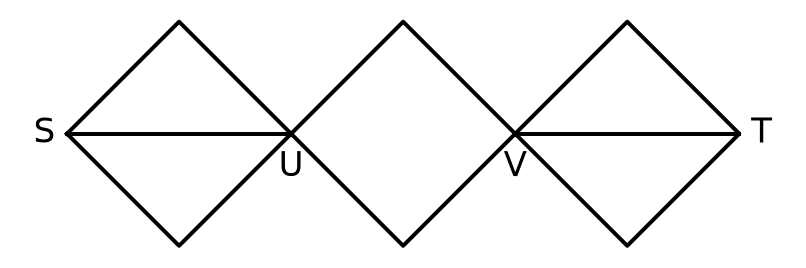
With reference to the figure given below, the number of different routes from S to T without retracing from U and/or V, is
Answer (d) & explanation
There are 18 routes (d). Step 1: break the journey into three parts. From S to U there are three paths: the top, the middle line and the bottom, so 3 ways. Step 2: from U to V there are two paths, top or bottom, so 2 ways. Step 3: from V to T there are again three paths, so 3 ways. Step 4: each choice can be combined with every other choice, so multiply: 3 × 2 × 3 = 18. Options (a), (b) and (c) add instead of multiplying or skip a part.
Tip: when a route passes through fixed points one after another, multiply the number of ways for each part. Add only when the routes are alternatives that do not combine.
Answer as per the official UPSC answer key.
If the 3rd day of a month is Monday, which one of the following will be the fifth day from 21st of this month?
Answer (c) & explanation
The fifth day from the 21st is a Wednesday (c). Step 1: the 3rd is a Monday. Add 7 at a time to find more Mondays: 3, 10, 17, 24. Step 2: "the fifth day from the 21st" means count five days after the 21st: 21 + 5 = the 26th. Step 3: the 24th is a Monday, so the 25th is Tuesday and the 26th is Wednesday. Options (a), (b) and (d) fall on the wrong day.
Tip: in calendar questions, jump in steps of 7 from a known day, because the weekday repeats every 7 days. Then count only the small gap that is left.
counting the 21st itself as day 1 gives the 25th (Tuesday). Fifth day from the 21st is the 26th.
Answer as per the official UPSC answer key.
If Sohan, while selling two goats at the same price, makes a profit of 10% on one goat and suffers a loss of 10% on the other
Answer (c) & explanation
He loses 1% (c). Step 1: take an easy selling price that works for both goats, say ₹99 each. Step 2: 10% profit means cost × 1.1 = 99, so cost = ₹90. 10% loss means cost × 0.9 = 99, so cost = ₹110. Step 3: total cost = 90 + 110 = ₹200. Total sale = 99 + 99 = ₹198. Loss = ₹2 on ₹200 = 1%. Option (a) is the trap: the profit and loss are on different costs, so they do not cancel. Options (b) and (d) are wrong.
Tip: whenever two things sell at the same price, one at x% profit and one at x% loss, there is always a loss of (x × x ÷ 100)%. Here 10 × 10 ÷ 100 = 1%.
"+10 and –10 cancel" is wrong. The cost prices differ.
Answer as per the official UPSC answer key.
Read the passage
Net profits are only 2·2% of their total assets for central public sector undertakings, lower than for the private corporate sector. While the public sector or the State-led entrepreneurship played an important role in triggering India’s industrialization, our evolving development needs, comparatively less-than-satisfactory performance of the public sector enterprises, the maturing of our private sector, a much larger social base now available for expanding entrepreneurship and the growing institutional capabilities to enforce competition policies would suggest that the time has come to review the role of public sector.
What should the portfolio composition of the government be ? It should not remain static all times. The airline industry works well as a purely private affair. At the opposite end, rural roads, whose sparse traffic makes tolling unviable, have to be on the balance-sheet of the State. If the government did not own rural roads, they would not exist. Similarly, public health capital in our towns and cities will need to come from the public sector. Equally, preservation and improvement of forest cover will have to be a new priority for the public sector assets.
Take the example of steel. With near-zero tariffs, India is a globally competitive market for the metal. Indian firms export steel into the global market, which demonstrates there is no gap in technology. Indian companies are buying up global steel companies, which shows there is no gap in capital availability. Under these conditions, private ownership works best.
Private ownership is clearly desirable in regulated industries, ranging from finance to infrastructure, where a government agency performs the function of regulation and multiple competing firms are located in the private sector. Here, the simple and clean solution — government as the umpire and the private sector as the players is what works best. In many of these industries, we have a legacy of government ownership, where productivity tends to be lower, fear of bankruptcy is absent, and the risk of asking for money from the tax payer is ever present. There is also the conflict of interest between government as an owner and as the regulator. The formulation and implementation of competition policy will be more vigorous and fair if government companies are out of action.
According to the passage, what is/are the reason/reasons for saying that the time has come to review the role of public sector ?
- 1. Now public sector has lost its relevance in the industrialization process.
- 2. Public sector does not perform satisfactorily.
- 3. Entrepreneurship in private sector is expanding.
- 4. Effective competition policies are available now.
Which of the statements given above is/are correct in the given context ?
Answer (c) & explanation
Reasons 2, 3 and 4 are given (c). Step 1: list the reasons in the passage. It cites "comparatively less-than-satisfactory performance" of public enterprises (item 2), "a much larger social base now available for expanding entrepreneurship" (item 3), and "growing institutional capabilities to enforce competition policies" (item 4). Step 2: test item 1. It is wrong: the passage says the public sector "played an important role" in India's industrialization. It never says it has lost all relevance. Options (a), (b) and (d) fail.
Tip: "time to review" a role is much milder than "it has lost relevance". Do not let a strong option replace a moderate idea in the text.
Answer as per the official UPSC answer key.
Read the passage
In recent times, India has grown fast not only compared to its own past but also in comparison with other nations. But there cannot be any room for complacency because it is possible for the Indian economy to develop even faster and also to spread the benefits of this growth more widely than has been done thus far. Before going into details of the kinds of micro-structural changes that we need to conceptualize and then proceed to implement, it is worthwhile elaborating on the idea of inclusive growth that constitutes the defining concept behind this Government’s various economic policies and decisions. A nation interested in inclusive growth views the same growth differently depending on whether the gains of the growth are heaped primarily on a small segment or shared widely by the population. The latter is cause for celebration but not the former. In other words, growth must not be treated as an end in itself but as an instrument for spreading prosperity to all. India’s own past experience and the experience of other nations suggests that growth is necessary for eradicating poverty but it is not a sufficient condition. In other words, policies for promoting growth need to be complemented with policies to ensure that more and more people join in the growth process and, further, that there are mechanisms in place to redistribute some of the gains to those who are unable to partake in the market process and, hence, get left behind.
A simple way of giving this idea of inclusive growth a sharper form is to measure a nation’s progress in terms of the progress of its poorest segment, for instance the bottom 20 per cent of the population. One could measure the per capita income of the bottom quintile of the population and also calculate the growth rate of income; and evaluate our economic success in terms of these measures that pertain to the poorest segment. This approach is attractive because it does not ignore growth like some of the older heterodox criteria did. It simply looks at the growth of income of the poorest sections of the population. It also ensures that those who are outside of the bottom quintile do not get ignored. If that were done, then those people would in all likelihood drop down into the bottom quintile and so would automatically become a direct target of our policies. Hence the criterion being suggested here is a statistical summing up of the idea of inclusive growth, which, in turn, leads to two corollaries : to wish that India must strive to achieve high growth and that we must work to ensure that the weakest segments benefit from the growth.
The author supports policies which will help
Answer (c) & explanation
The author wants growth plus redistribution (c). Step 1: find the policy line. Growth policies "need to be complemented" with policies that bring more people into growth and mechanisms "to redistribute some of the gains" to those "left behind". Step 2: test the others. Option (a) is wrong: it keeps only growth and drops redistribution. Option (b) is wrong: the author's method "does not ignore growth", so "irrespective of rate of growth" contradicts him. Option (d) is wrong: the poorest matter, but the author also wants high growth and does not ignore those outside the bottom 20%.
Tip: when one option combines both halves of the author's argument, and the others hold only one half, the combined option is usually right.
Answer as per the official UPSC answer key.
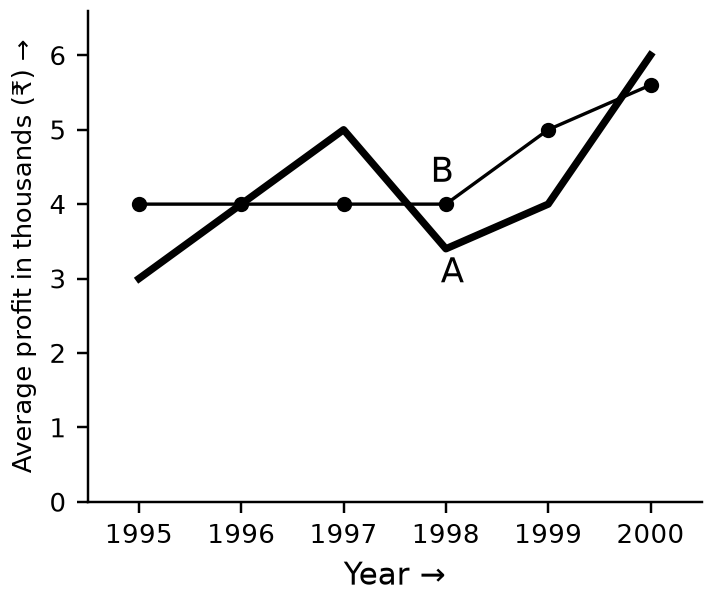
Directions for the following 4 (four) items : The following graph shows the average profit of two fruit-sellers A and B in thousands (₹) per year from the year 1995 to 2000. Consider the graph and answer the 4 (four) items that follow :
In which year is the average profit of A and B same ?
Answer (b) & explanation
Their profits are equal in 1996 (b). Step 1: read B's line on the graph. B's dotted line stays flat at ₹4,000 from 1995 to 1998. Step 2: read A's thick line. It crosses the 4 thousand level exactly at 1996. So in that year both sellers earn ₹4,000. Step 3: check the other years. In 1995, 1997 and 1998, A's line is above or below 4, so options (a), (c) and (d) fail.
Tip: on a two-line graph, "same value" means the point where the two lines cross or touch. Look for the meeting point first, then read the year below it.
Answer as per the official UPSC answer key.
Examine the following statements :
- 1. George attends Music classes on Monday.
- 2. He attends Mathematics classes on Wednesday.
- 3. His Literature classes are not on Friday.
- 4. He attends History classes on the day following the day of his Mathematics classes.
- 5. On Tuesday, he attends his Sports classes.
If he attends just one subject in a day and his Sunday is free, then he is also free on
Answer (d) & explanation
He is free on Friday (d). Step 1: fill in the week. Monday: Music. Tuesday: Sports. Wednesday: Mathematics. Thursday: History, the day after Mathematics. Sunday: free. Step 2: only Friday and Saturday are left for Literature. Literature is not on Friday, so it is on Saturday. Step 3: that leaves Friday free. Options (a), (b) and (c) are all filled days.
Tip: in scheduling puzzles, place the fixed clues first (named days), then the relative clues ("the day after"), and use the negative clue ("not on Friday") last to settle what is left.
Answer as per the official UPSC answer key.
Read the passage
Climate change poses potentially devastating effects on India’s agriculture. While the overall parameters of climate change are increasingly accepted — a 1°C average temperature increase over the next 30 years, sea level rise of less than 10 cm in the same period, and regional monsoon variations and corresponding droughts — the impacts in India are likely to be quite site and crop specific. Some crops may respond favourably to the changing conditions, others may not. This emphasizes the need to promote agricultural research and create maximum flexibility in the system to permit adaptations.
The key ingredient for “drought proofing” is the managed recharge of aquifers. To ensure continued yields of important staple crops (e.g. wheat), it may also be necessary to shift the locations where these crops are grown, in response to temperature changes as well as to water availability. The latter will be a key factor in making long term investment decisions.
For example, water runoff from the Himalayas is predicted to increase over the next 30 years as glaciers melt, but then decline substantially thereafter. It will be critical to provide incentives to plan for these large-scale shifts in agro-ecological conditions.
India needs to make long term investment in research and development in agriculture. India is likely to experience changed weather patterns in future.
Consider the following statements :
Climate change may force the shifting of locations of the existing crops due to
- 1. melting of glaciers.
- 2. water availability and temperature suitability at other locations.
- 3. poor productivity of crops.
- 4. wider adaptability of crop plants.
Select the correct answer using the code given below :
Answer (b) & explanation
Water, temperature and yields drive the shift (b). Step 1: find the sentence. To keep "continued yields" of staple crops, it may be necessary to shift where crops are grown "in response to temperature changes as well as to water availability". That gives item 2 (water and temperature) and item 3 (poor productivity, the reason yields would fall). Step 2: test the others. Item 1 is not taken by UPSC's key: glacier melt is mentioned only as an example of changing runoff, not as the direct reason for shifting crops. Item 4 is wrong: wider adaptability would let crops stay where they are. So options (a), (c) and (d) fail.
Tip: separate the reason the author gives from examples used to illustrate it.
Answer as per the official UPSC answer key.
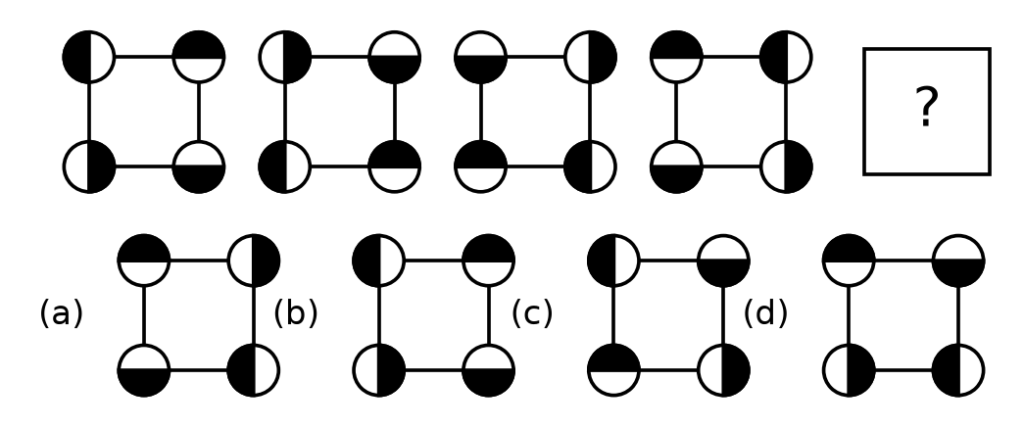
Consider the following figures :
Change in positions of beads in the four figures above follows a sequence. Following the same sequence, which of the figures below should appear as the fifth figure above ?
Answer (b) & explanation
Figure (b) comes fifth (b). Step 1: follow one bead at a time. The top-left bead's dark half moves left, then right, then bottom, then top across the four figures. Step 2: check another bead, the top-right one: top, bottom, right, left. Each bead runs through a 4-step cycle. Step 3: after four steps the cycle starts again, so the fifth figure must look like the first: dark halves left, top, right, bottom. That is figure (b). Options (a), (c) and (d) do not repeat the first figure.
Tip: in sequence questions, if a pattern seems to have four distinct positions, the fifth figure is often a repeat of the first. Check one element at a time.
Answer as per the official UPSC answer key.
For a charity show, the total tickets sold were 420. Half of these tickets were sold at the rate of ₹ 5 each, one-third at the rate of ₹ 3 each and the rest for ₹ 2 each. What was the total amount received?
Answer (c) & explanation
The total collected is ₹1,610 (c). Step 1: split the 420 tickets. Half = 210 tickets at ₹5 = ₹1,050. One-third = 140 tickets at ₹3 = ₹420. Step 2: the rest = 420 − 210 − 140 = 70 tickets at ₹2 = ₹140. Step 3: total = 1,050 + 420 + 140 = ₹1,610. Options (a), (b) and (d) come from miscounting "the rest".
Tip: always work out "the rest" by subtracting from the total, not by guessing a fraction. Here half plus one-third is five-sixths, so the rest is one-sixth: 420 ÷ 6 = 70.
Answer as per the official UPSC answer key.
Out of a total of 120 musicians in a club, 5% can play all the three instruments, guitar, violin and flute. It so happens that the number of musicians who can play any two and only two of the above instruments is 30. The number of musicians who can play the guitar alone is 40. What is the total number of those who can play violin alone or flute alone ?
Answer (b) & explanation
44 play only the violin or only the flute (b). Step 1: work out each group. All three instruments: 5% of 120 = 6. Exactly two instruments: 30. Guitar alone: 40. Step 2: everyone else plays only one of the other two, violin alone or flute alone. So 120 − 6 − 30 − 40 = 44. This assumes every musician plays at least one of the three. Options (a), (c) and (d) do not match.
Tip: in such questions, split the total into non-overlapping groups: all three, exactly two, and each one alone. They must add up to the total, so the missing group is the total minus the rest.
Answer as per the official UPSC answer key.