
CSAT (Paper II): previous-year questions
1280 real UPSC Prelims questions (2011–2026) with the official answer and a clear explanation. 400 of them came in the last five papers.
How often UPSC asks this
Questions per year, counted from the official papers.
Subtopics
Arrangements, ranking, ordering and puzzles
142 questions
Clocks and calendars
5 questions
Coding-decoding, series, patterns, cubes, dice and visual reasoning
110 questions
Communication, interpersonal skills and decision-making
10 questions
Counting, permutations, combinations and probability
1 questions
Directions, blood relations and Venn diagrams
60 questions
General English: grammar, vocabulary and comprehension
20 questions
General Hindi: grammar, vocabulary, dialects and comprehension
25 questions
Geometry and mensuration
26 questions
Number system and basic algebra (divisibility, HCF/LCM, remainders, digits, equations)
196 questions
Percentages, profit and loss, discount, simple and compound interest
47 questions
Ratio, proportion, averages, mixtures and alligation
47 questions
Syllogisms, statements and conclusions, assumptions and arguments
89 questions
Time and work; pipes and cisterns
2 questions
Time, speed and distance; trains, boats and streams; races
48 questions
Attempt the questions
Newest papers first. Tap an option; the answer and the reason appear instantly.
Read the passage
The law in many parts of the world increasingly restricts the discharge of agricultural slurry into watercourses. The simplest and often the most economically sound practice returns the material to the land as semisolid manure or as sprayed slurry. This dilutes its concentration in the environment to what might have occurred in a more primitive and sustainable type of agriculture and converts pollutant into fertilizer. Soil microorganisms decompose the organic components of sewage and slurry and most of the mineral nutrients become available to be absorbed again by the vegetation.
The excess input of nutrients, both nitrogen and phosphorus — based, from agricultural runoff (and human sewage) has caused many ‘healthy’ oligotrophic lakes (low nutrient concentrations, low plant productivity with abundant water weeds, and clear water) to change to eutrophic condition where high nutrient inputs lead to high phytoplankton productivity (sometimes dominated by bloom-forming toxic species). This makes the water turbid, eliminates large plants and, in the worst situations, leads to anoxia and fish kills; so called cultural eutrophication. Thus, important ecosystem services are lost, including the provisioning service of wild-caught fish and the cultural services associated with recreation.
The process of cultural eutrophication of lakes has been understood for some time. But only recently did scientists notice huge ‘dead zones’ in the oceans near river outlets, particularly those draining large catchment areas such as the Mississippi in North America and the Yangtze in China. The nutrient-enriched water flows through streams, rivers and lakes, and eventually to the estuary and ocean where the ecological impact may be huge, killing virtually all invertebrates and fish in areas up to 70,000 km² in extent. More than 150 sea areas worldwide are now regularly starved of oxygen as a result of decomposition of algal blooms, fuelled particularly by nitrogen from agricultural runoff of fertilizers and sewage from large cities. Oceanic dead zones are typically associated with industrialized nations and usually lie off countries that subsidize their agriculture, encouraging farmers to increase productivity and use more fertilizer.
According to the passage, why should the discharge of agricultural slurry into watercourses be restricted ?
- 1. Losing nutrients in this way is not a good practice economically.
- 2. Watercourses do not contain the microorganisms that can decompose organic components of agricultural slurry.
- 3. The discharge may lead to the eutrophication of water bodies.
Select the correct answer using the codes given below :
Answer (c) & explanation
1 and 3 are correct (c). Step 1: the passage calls returning slurry to the land 'often the most economically sound practice', which turns 'pollutant into fertilizer'. Dumping it in water wastes these nutrients, so 1 is right. Step 2: the passage shows that nutrients from runoff cause eutrophication of lakes and 'dead zones' in the sea, so 3 is right. Step 3: statement 2 is wrong: the passage talks of soil microorganisms, but never says watercourses lack them. So (a), (b) and (d) fail.
Tip: 'never discussed' is enough to reject a statement. Do not accept a point because it sounds scientific; it must come from the passage.
Answer as per the official UPSC answer key.
Read the passage
It was already late when we set out for the next town, which according to the map was about fifteen kilometres away on the other side of the hills. There we felt that we would find a bed for the night. Darkness fell soon after we left the village, but luckily we met no one as we drove swiftly along the narrow winding road that led to the hills. As we climbed higher, it became colder and rain began to fall, making it difficult at times to see the road. I asked John, my companion, to drive more slowly. After we had travelled for about twenty kilometres, there was still no sign of the town which was marked on the map. We were beginning to get worried. Then without warning, the car stopped and we found we had run out of petrol.
The author asked John to drive more slowly because
Answer (c) & explanation
(c) is correct. Step 1: the passage says 'rain began to fall, making it difficult at times to see the road. I asked John… to drive more slowly.' So the reason was poor visibility. Step 2: (a) is wrong: the road leading to the hills was true all along; the request came only when it became hard to see. Step 3: (b) is wrong: John's driving experience is never mentioned. (d) is wrong: the passage does not say they were in wilderness. So (a), (b) and (d) fail.
Tip: when the cause and the action are in back-to-back sentences, the first usually explains the second. Look for what changed just before the action.
Answer as per the official UPSC answer key.
(Same information as the question above.)
If B is selected and Y is rejected, the team will consist of which one of the following groups?
Answer (c) & explanation
A, B, C and X is correct (c). Step 1: Y is rejected, so (d), which includes Y and has only one male (A), is out. Step 2: (a) puts B with W, which is not allowed. (b) puts C with Z, which is not allowed. Step 3: (c) A, B, C and X breaks no rule: X has no restrictions, and B, C are not paired with W or Z. It also has three males, meeting the 'at least 2 males' rule. So (a), (b) and (d) fail.
Tip: in team questions with ready options, test each option against every rule. One broken rule rules it out. This is often faster than building the team from scratch.
Answer as per the official UPSC answer key.
Consider the following matrix:
| 3 | 370 | 7 |
|---|---|---|
| 2 | 224 | 6 |
| 1 | 730 | X |
What is the number at 'X' in the above matrix?
Answer (c) & explanation
1. Row 1: 3 × 3 × 3 = 27 and 7 × 7 × 7 = 343. 27 + 343 = 370, the middle number.
2. Row 2: 2 × 2 × 2 = 8 and 6 × 6 × 6 = 216. 8 + 216 = 224. The rule holds.
3. Row 3: 1 + (X × X × X) = 730, so X × X × X = 729 = 9 × 9 × 9.
4. X = 9.
Answer as per the official UPSC answer key.
You are a teacher in a University and are setting a question paper on a particular subject. One of your colleagues, whose son is preparing for the examination on that subject, comes to you and informs you that it is his son’s last chance to pass that examination and whether you could help him by indicating what questions are going to be in the examination. In the past, your colleague had helped you in another matter. Your colleague informs you that his son will suffer from depression if he fails in this examination. In such circumstances, what would you do?
Answer (b) & explanation
(b) and (c) are both correct (UPSC accepted both; no negative marking). Step 1: a colleague asks you to leak exam questions for his son. This would break the trust placed in you as a paper-setter. Step 2: (b) politely refusing, and (c) refusing while explaining that it would violate the university's trust, both protect the exam's fairness. Step 3: (a) helping him because he once helped you is a serious breach of duty. (d) reporting him at once is harsher than a first, emotional request needs; a clear refusal is enough.
Tip: for these interpersonal items, pick the response that is lawful, honest and fixes the real problem through proper channels. Avoid options that give in to pressure, show favouritism or dodge a decision.
Answer as per the official UPSC answer key.
Read the passage
Financial markets in India have acquired greater depth and liquidity over the years. Steady reforms since 1991 have led to growing linkages and integration of the Indian economy and its financial system with the global economy. Weak global economic prospects and continuing uncertainties in the international financial markets therefore, have had their impact on the emerging market economies. Sovereign risk concerns, particularly in the Euro area, affected financial markets for the greater part of the year, with the contagion of Greece’s sovereign debt problem spreading to India and other economies by way of higher-than-normal levels of volatility.
The funding constraints in international financial markets could impact both the availability and cost of foreign funding for banks and corporates. Since the Indian financial system is bank dominated, banks’ ability to withstand stress is critical to overall financial stability. Indian banks, however, remain robust, notwithstanding a decline in capital to risk-weighted assets ratio and a rise in non-performing asset levels in the recent past. Capital adequacy levels remain above the regulatory requirements. The financial market infrastructure continues to function without any major disruption. With further globalization, consolidation, deregulation, and diversification of the financial system, the banking business may become more complex and riskier. Issues like risk and liquidity management and enhancing skill therefore assume greater significance.
Risk and liquidity management assumes more importance in the Indian banking system in future due to
- 1. further globalization.
- 2. more consolidation and deregulation of the financial system.
- 3. further diversification of the financial system.
- 4. more financial inclusion in the economy.
Select the correct answer using the code given below :
Answer (a) & explanation
1, 2 and 3 are correct (a). Step 1: the passage says: 'With further globalization, consolidation, deregulation, and diversification of the financial system, the banking business may become more complex and riskier.' So risk and liquidity management matters more because of 1, 2 and 3. Step 2: point 4, financial inclusion, is not mentioned anywhere. Step 3: (b) and (d) include 4, and (c) leaves out 3. So (b), (c) and (d) fail.
Tip: match each point to a word in the sentence. When the passage gives a list, the correct option usually repeats that list exactly; any extra item from general knowledge is a trap.
Answer as per the official UPSC answer key.
Read the passage
Ecological research over the last quarter of the century has established the deleterious effects of habitat fragmentation due to mining, highways and such other intrusions on forests. When a large block of forests gets fragmented into smaller bits, the edges of all these bits come into contact with human activities resulting in the degradation of the entire forests. Continuity of forested landscapes and corridors gets disrupted affecting several extinction-prone species of wildlife. Habitat fragmentation is therefore considered as the most serious threat to biodiversity conservation. Ad hoc grants of forest lands to mining companies coupled with rampant illegal mining is aggravating this threat.
What is the purpose of maintaining the continuity of forested landscapes and corridors ?
- 1. Preservation of biodiversity.
- 2. Management of mineral resources.
- 3. Grant of forest lands for human activities.
Select the correct answer using the codes given below :
Answer (a) & explanation
Only 1 is correct (a). Step 1: the passage says when continuity of forests and corridors is broken, it affects 'several extinction-prone species of wildlife'. So keeping forests connected helps preserve biodiversity (1). Step 2: point 2, managing mineral resources, is wrong: mining is described as a threat to forests, not a purpose of corridors. Step 3: point 3, granting forest land for human activities, is wrong: such grants cause fragmentation; they are the problem. So (b), (c) and (d) fail.
Tip: ask whether an option is the goal or the threat. Here mining and land grants are the threats, and saving wildlife is the goal. Wildlife corridors let animals move between forest patches and keep populations healthy.
Answer as per the official UPSC answer key.
Read the passage
Malnutrition most commonly occurs between the ages of six months and two years. This happens despite the child’s food requirements being less than that of an older child. Malnutrition is often attributed to poverty, but it has been found that even in households where adults eat adequate quantities of food, more than 50 per cent of children-under-five do not consume enough food. The child’s dependence on someone else to feed him/her is primarily responsible for the malnutrition. Very often the mother is working and the responsibility of feeding the young child is left to an older sibling. It is therefore crucial to increase awareness regarding the child’s food needs and how to satisfy them.
According to the author, poverty is not the main cause of malnutrition, but the fact that
- 1. taking care of younger ones is not a priority for working mothers.
- 2. awareness of nutritional needs is not propagated by the Public Health authorities.
Select the correct answer using the code given below :
Answer (b) & explanation
Only statement 2 is the key (b). Step 1: the passage says even well-fed families have hungry children, so the real cause is that people do not know a child's food needs. It calls for 'increasing awareness', which suggests awareness is not being spread: the key reads this as statement 2. Step 2: note that the passage never names Public Health authorities, so statement 2 is a loose fit; it is DOUBTFUL, and (d) is arguable. Step 3: statement 1 is wrong: working mothers lack time, so older siblings feed the child; nothing says the child is not a priority for them. So (a) and (c) fail.
Tip: when an option adds a new actor (here, health authorities), check carefully. UPSC sometimes accepts it if the core idea matches.
Answer as per the official UPSC answer key.
Read the passage
The law in many parts of the world increasingly restricts the discharge of agricultural slurry into watercourses. The simplest and often the most economically sound practice returns the material to the land as semisolid manure or as sprayed slurry. This dilutes its concentration in the environment to what might have occurred in a more primitive and sustainable type of agriculture and converts pollutant into fertilizer. Soil microorganisms decompose the organic components of sewage and slurry and most of the mineral nutrients become available to be absorbed again by the vegetation.
The excess input of nutrients, both nitrogen and phosphorus — based, from agricultural runoff (and human sewage) has caused many ‘healthy’ oligotrophic lakes (low nutrient concentrations, low plant productivity with abundant water weeds, and clear water) to change to eutrophic condition where high nutrient inputs lead to high phytoplankton productivity (sometimes dominated by bloom-forming toxic species). This makes the water turbid, eliminates large plants and, in the worst situations, leads to anoxia and fish kills; so called cultural eutrophication. Thus, important ecosystem services are lost, including the provisioning service of wild-caught fish and the cultural services associated with recreation.
The process of cultural eutrophication of lakes has been understood for some time. But only recently did scientists notice huge ‘dead zones’ in the oceans near river outlets, particularly those draining large catchment areas such as the Mississippi in North America and the Yangtze in China. The nutrient-enriched water flows through streams, rivers and lakes, and eventually to the estuary and ocean where the ecological impact may be huge, killing virtually all invertebrates and fish in areas up to 70,000 km² in extent. More than 150 sea areas worldwide are now regularly starved of oxygen as a result of decomposition of algal blooms, fuelled particularly by nitrogen from agricultural runoff of fertilizers and sewage from large cities. Oceanic dead zones are typically associated with industrialized nations and usually lie off countries that subsidize their agriculture, encouraging farmers to increase productivity and use more fertilizer.
The passage refers to the conversion of “pollutant to fertilizer”. What is pollutant and what is fertilizer in this context ?
Answer (b) & explanation
(b) is correct. Step 1: slurry dumped into watercourses is a pollutant. When returned to land, soil microorganisms decompose it, and 'most of the mineral nutrients become available to be absorbed again by the vegetation'. So decomposed slurry in the soil acts as fertilizer. Step 2: (a) is wrong: microorganisms are the agents that break down the slurry, not the fertilizer itself. Step 3: (c) is wrong: a watercourse cannot be a fertilizer, and spraying slurry on land is the remedy, not the pollution. Since (b) is right, (d) fails.
Tip: in 'what is X and what is Y' questions, check both halves of each option. One wrong half rejects the whole option.
Answer as per the official UPSC answer key.
Read the passage
It was already late when we set out for the next town, which according to the map was about fifteen kilometres away on the other side of the hills. There we felt that we would find a bed for the night. Darkness fell soon after we left the village, but luckily we met no one as we drove swiftly along the narrow winding road that led to the hills. As we climbed higher, it became colder and rain began to fall, making it difficult at times to see the road. I asked John, my companion, to drive more slowly. After we had travelled for about twenty kilometres, there was still no sign of the town which was marked on the map. We were beginning to get worried. Then without warning, the car stopped and we found we had run out of petrol.
The travellers set out for the town although it was getting dark because
Answer (d) & explanation
(d) is correct. Step 1: the passage says the town was 'about fifteen kilometres away' and 'there we felt that we would find a bed for the night'. So they set out because the town was near and offered a place to rest: (d). Step 2: (b) is wrong: its first half is right, but nothing calls the town a hill-resort. Step 3: (a) is wrong: being in a hurry is not mentioned. (c) is wrong: they had just left a village, not a wilderness. So (a), (b) and (c) fail.
Tip: when two options share the same first half, the difference lies in the second half. Check that half against the passage.
Answer as per the official UPSC answer key.
(Same information as the question above.)
If all the three males are selected, then how many combinations of four member teams are possible?
Answer (b) & explanation
2 teams is correct (b). Step 1: A, B and C are all selected, so we need exactly one woman to make four. Step 2: W cannot play with B, so W is out. Z cannot play with C, so Z is out. Step 3: X and Y have no problem with A, B or C (the W–Y rule does not apply, since only one woman is chosen). So the possible teams are A, B, C, X and A, B, C, Y: 2 combinations. So (a), (c) and (d) fail.
Tip: count only the free choices. Once three places are fixed, ask how many candidates can fill the last place without breaking any rule.
Answer as per the official UPSC answer key.
Four cars are hired at the rate of ₹ 6 per km plus the cost of diesel at ₹ 40 a litre. In this context, consider the details given in the following table:
| Car | Mileage (km/l) | Hours | Total Payment (₹) |
|---|---|---|---|
| A | 8 | 20 | 2120 |
| B | 10 | 25 | 1950 |
| C | 9 | 24 | 2064 |
| D | 11 | 22 | 1812 |
Which car maintained the maximum average speed?
Answer (a) & explanation
1. Find the cost of 1 km for each car: ₹ 6 hire + diesel (₹ 40 ÷ mileage).
2. A: 6 + 40 ÷ 8 = ₹ 11 per km. Distance = 2120 ÷ 11 ≈ 193 km. Speed ≈ 193 ÷ 20 ≈ 9·6 km/h.
3. B: 6 + 4 = ₹ 10 per km. Distance = 195 km. Speed = 195 ÷ 25 = 7·8 km/h.
4. C: 6 + 4·44 = ₹ 10·44 per km. Distance ≈ 198 km. Speed ≈ 198 ÷ 24 ≈ 8·2 km/h.
5. D: 6 + 3·64 = ₹ 9·64 per km. Distance ≈ 188 km. Speed ≈ 188 ÷ 22 ≈ 8·5 km/h.
6. The highest speed is for Car A.
Answer as per the official UPSC answer key.
There are five hobby clubs in a college viz, photography, yachting, chess, electronics and gardening. The gardening group meets every second day, the electronics group meets every third day, the chess group meets every fourth day, the yachting group meets every fifth day and the photography group meets every sixth day. How many times do all the five groups meet on the same day within 180 days?
Answer (a) & explanation
3 times is correct (a). Step 1: all five groups meet on the same day only when the day number is a multiple of 2, 3, 4, 5 and 6 together. Step 2: the LCM of 2, 3, 4, 5 and 6 is 60. (4 = 2², 6 = 2 × 3, so LCM = 2² × 3 × 5 = 60.) Step 3: within 180 days, the common days are 60, 120 and 180, which is 3 times. So (b), (c) and (d) fail.
Tip: 'meet together every…' questions are LCM questions. Then divide the period by the LCM (180 ÷ 60 = 3). Check the wording: if day 0 were counted as a meeting day, the answer would change, but here the count starts after day 0.
Answer as per the official UPSC answer key.
In a rare coin collection, there is one gold for every three non-gold coins. 10 more gold coins are added to the collection and the ratio of gold coins to non-gold coins would be 1 : 2. Based on the information, the total number of coins in the collection now becomes
Answer (a) & explanation
90 is correct (a). Step 1: gold to non-gold is 1 : 3, so let gold = k and non-gold = 3k. Non-gold coins do not change. Step 2: after adding 10 gold coins, (k + 10) : 3k = 1 : 2. So 2(k + 10) = 3k, which gives 2k + 20 = 3k, and k = 20. Step 3: now gold = 20 + 10 = 30 and non-gold = 60. Total = 90. Check: 30 : 60 = 1 : 2. So (b), (c) and (d) fail.
Tip: in ratio-change questions, fix the quantity that stays the same (non-gold coins here) and build the equation around it. Always check the new ratio with your final numbers.
the question asks for the total now, after adding 10. 80 is the old total.
Fell for this one? Most aspirants do. The PYQ Book puts every UPSC trap side by side, so the pattern finally clicks. Try the free sample
Answer as per the official UPSC answer key.
Read the passage
A number of empirical studies find that farmers are risk-averse, though only moderately in many cases. There is also evidence to show that farmers’ risk aversion results in cropping patterns and input use designed to reduce risk rather than to maximize income. Farmers adopt a number of strategies to manage and cope with agricultural risks. These include practices like crop and field diversification, non-farm employment, storage of stocks and strategic migration of family members. There are also institutions ranging from share tenancy to kinship, extended family and informal credit agencies. One major obstacle to risk sharing by farmers is that the same type of risks can affect a large number of farmers in the region. Empirical studies show that the traditional methods are not adequate. Hence there is a need for policy interventions, especially measures that cut across geographical regions.
Policies may aim at tackling agricultural risks directly or indirectly. Examples of risk-specific policies are crop insurance, price stabilization and the development of varieties resistant to pests and diseases. Policies which affect risk indirectly are irrigation, subsidized credit and access to information. No single risk-specific policy is sufficient to reduce risk and is without side-effects, whereas policies not specific to risk influence the general situation and affect risks only indirectly. Crop insurance, as a policy measure to tackle agricultural risk directly, deserves careful consideration in the Indian context and in many other developing countries — because the majority of farmers depend on rain-fed agriculture and in many areas yield variability is the predominant cause of their income instability.
The need for policy intervention to mitigate risks in agriculture is because
Answer (c) & explanation
(c) is correct. Step 1: the passage lists farmers' own strategies (diversifying crops, non-farm jobs, storing stocks, migration) and institutions like share tenancy and kinship. Then it says: 'the traditional methods are not adequate. Hence there is a need for policy interventions.' So (c) gives the stated reason. Step 2: (a) is wrong: farmers are only 'moderately' risk-averse, not 'extremely'. (b) is wrong: farmers do know many ways to handle risk. Step 3: (d) is true, but it is the reason crop insurance in particular deserves attention, not the reason for policy intervention in general. So (a), (b) and (d) fail.
Tip: words like 'hence' and 'therefore' link a cause to its result; the sentence before them is the answer.
Answer as per the official UPSC answer key.
Read the passage
The law in many parts of the world increasingly restricts the discharge of agricultural slurry into watercourses. The simplest and often the most economically sound practice returns the material to the land as semisolid manure or as sprayed slurry. This dilutes its concentration in the environment to what might have occurred in a more primitive and sustainable type of agriculture and converts pollutant into fertilizer. Soil microorganisms decompose the organic components of sewage and slurry and most of the mineral nutrients become available to be absorbed again by the vegetation.
The excess input of nutrients, both nitrogen and phosphorus — based, from agricultural runoff (and human sewage) has caused many ‘healthy’ oligotrophic lakes (low nutrient concentrations, low plant productivity with abundant water weeds, and clear water) to change to eutrophic condition where high nutrient inputs lead to high phytoplankton productivity (sometimes dominated by bloom-forming toxic species). This makes the water turbid, eliminates large plants and, in the worst situations, leads to anoxia and fish kills; so called cultural eutrophication. Thus, important ecosystem services are lost, including the provisioning service of wild-caught fish and the cultural services associated with recreation.
The process of cultural eutrophication of lakes has been understood for some time. But only recently did scientists notice huge ‘dead zones’ in the oceans near river outlets, particularly those draining large catchment areas such as the Mississippi in North America and the Yangtze in China. The nutrient-enriched water flows through streams, rivers and lakes, and eventually to the estuary and ocean where the ecological impact may be huge, killing virtually all invertebrates and fish in areas up to 70,000 km² in extent. More than 150 sea areas worldwide are now regularly starved of oxygen as a result of decomposition of algal blooms, fuelled particularly by nitrogen from agricultural runoff of fertilizers and sewage from large cities. Oceanic dead zones are typically associated with industrialized nations and usually lie off countries that subsidize their agriculture, encouraging farmers to increase productivity and use more fertilizer.
According to the passage, what are the effects of indiscriminate use of fertilizers ?
- 1. Addition of pollutants to the soil and water.
- 2. Destruction of decomposer microorganisms in soil.
- 3. Nutrient enrichment of water bodies.
- 4. Creation of algal blooms.
Select the correct answer from the codes given below :
Answer (b) & explanation
1, 3 and 4 are correct (b). Step 1: fertilizer runoff adds excess nitrogen and phosphorus to soil and water, which pollutes them (1). Step 2: this nutrient enrichment turns clear lakes eutrophic (3), and the passage says dead zones are caused by 'algal blooms, fuelled particularly by nitrogen from agricultural runoff of fertilizers' (4). Step 3: point 2, destruction of soil decomposers, is never mentioned; the passage actually shows soil microbes working. So (a), (c) and (d) fail.
Tip: list the chain the passage describes: fertilizer → runoff → nutrient-rich water → algal blooms → no oxygen → dead fish. Any effect outside this chain is likely a trap.
Answer as per the official UPSC answer key.
Read the passage
It was already late when we set out for the next town, which according to the map was about fifteen kilometres away on the other side of the hills. There we felt that we would find a bed for the night. Darkness fell soon after we left the village, but luckily we met no one as we drove swiftly along the narrow winding road that led to the hills. As we climbed higher, it became colder and rain began to fall, making it difficult at times to see the road. I asked John, my companion, to drive more slowly. After we had travelled for about twenty kilometres, there was still no sign of the town which was marked on the map. We were beginning to get worried. Then without warning, the car stopped and we found we had run out of petrol.
The travellers were worried after twenty kilometres because
Answer (b) & explanation
(b) is correct. Step 1: the map showed the town about fifteen kilometres away, but after about twenty kilometres there was 'still no sign of the town'. So they feared they had lost their way: (b). Step 2: (c) and (d) are wrong: the rain and the cold had started earlier, while they climbed; the worry came after they found no town. Step 3: (a) is wrong: a lonely countryside is not given as the reason. So (a), (c) and (d) fail.
Tip: match the worry to the new fact that appears just before it. Here the new fact is 'no sign of the town' after travelling further than the map said.
Answer as per the official UPSC answer key.
The music director of a film wants to select four persons to work on different aspects of the composition of a piece of music. Seven persons are available for this work; they are Rohit, Tanya, Shobha, Kaushal, Kunal, Mukesh and Jaswant.
Rohit and Tanya will not work together. Kunal and Shobha will not work together. Mukesh and Kunal want to work together.
Which of the following is the most acceptable group of people that can be selected by the music director?
Answer (c) & explanation
(c) is correct. Step 1: the rules are: Rohit and Tanya not together; Kunal and Shobha not together; Mukesh and Kunal together. Step 2: (a) has Kunal with Shobha: not allowed, and Kunal is without Mukesh. (b) has Rohit with Tanya: not allowed. (d) has Rohit with Tanya too, and Mukesh without Kunal. Step 3: (c) Tanya, Mukesh, Kunal and Jaswant breaks no rule and keeps Mukesh and Kunal together. So (a), (b) and (d) fail.
Tip: treat 'want to work together' as a pair that must come as a unit. Any option with only one of the pair fails, just like an option that joins two people who refuse to work together.
Answer as per the official UPSC answer key.
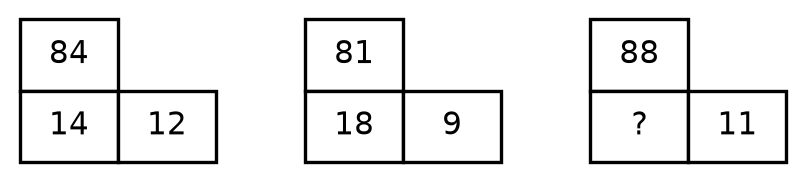
Examine the following three figures in which the numbers follow a specific pattern:
The missing number (?) in the third figure above is
Answer (b) & explanation
16 is correct (b). Step 1: in the first figure, 14 × 12 = 168, and half of 168 is 84, the top number. Step 2: in the second figure, 18 × 9 = 162, and half is 81. The rule holds: top number = (product of the two bottom numbers) ÷ 2. Step 3: in the third figure, ? × 11 must equal 2 × 88 = 176. So ? = 176 ÷ 11 = 16. So (a), (c) and (d) fail.
Tip: in number figures, try simple operations (add, multiply, half, double) on the given numbers and check the rule on every complete figure before using it on the missing one.
Answer as per the official UPSC answer key.
A, B, C, D and E belong to five different cities P, Q, R, S and T (not necessarily in that order). Each one of them comes from a different city. Further it is given that
- 1. B and C do not belong to Q.
- 2. B and E do not belong to P and R.
- 3. A and C do not belong to R, S and T.
- 4. D and E do not belong to Q and T.
Which one of the following statements is not correct?
Answer (d) & explanation
'B belongs to S' is not correct (d). Step 1: from clue 3, A and C are not in R, S or T, so they are in P or Q. Clue 1 says C is not in Q, so C = P and A = Q. Step 2: clue 4 says E is not in Q or T, and clue 2 says E is not in P or R, so E = S. Clue 4 says D is not in T, so D = R, and B = T. Step 3: so C belongs to P (true), D to R (true), A to Q (true), but B belongs to T, not S. So (a), (b) and (c) are correct statements and (d) is the incorrect one.
Tip: in 'not correct' questions, solve fully first, then pick the false statement. Start with people who have only two possible cities.
Answer as per the official UPSC answer key.