
CSAT (Paper II): previous-year questions
1280 real UPSC Prelims questions (2011–2026) with the official answer and a clear explanation. 400 of them came in the last five papers.
How often UPSC asks this
Questions per year, counted from the official papers.
Subtopics
Arrangements, ranking, ordering and puzzles
142 questions
Clocks and calendars
5 questions
Coding-decoding, series, patterns, cubes, dice and visual reasoning
110 questions
Communication, interpersonal skills and decision-making
10 questions
Counting, permutations, combinations and probability
1 questions
Directions, blood relations and Venn diagrams
60 questions
General English: grammar, vocabulary and comprehension
20 questions
General Hindi: grammar, vocabulary, dialects and comprehension
25 questions
Geometry and mensuration
26 questions
Number system and basic algebra (divisibility, HCF/LCM, remainders, digits, equations)
196 questions
Percentages, profit and loss, discount, simple and compound interest
47 questions
Ratio, proportion, averages, mixtures and alligation
47 questions
Syllogisms, statements and conclusions, assumptions and arguments
89 questions
Time and work; pipes and cisterns
2 questions
Time, speed and distance; trains, boats and streams; races
48 questions
Attempt the questions
Newest papers first. Tap an option; the answer and the reason appear instantly.
A gardener has 1000 plants. He wants to plant them in such a way that the number of rows and the number of columns remains the same. What is the minimum number of plants that he needs more for this purpose?
Answer (b) & explanation
24 is correct (b). Step 1: equal rows and columns means the plants form a square, so the total must be a perfect square. Step 2: 31² = 961, which is less than 1,000, so too small. The next square is 32² = 1,024. Step 3: he needs 1,024 − 1,000 = 24 more plants. (a) 14 gives 1,014, (c) 32 gives 1,032 and (d) 34 gives 1,034, none of which is a perfect square. So (a), (c) and (d) fail.
Tip: learn squares up to 35 or so; they save time in CSAT. 'Minimum number to add' means go up to the next perfect square; 'minimum to remove' means go down to the one before it (here 961, removing 39).
Answer as per the official UPSC answer key.
Read the passage
A number of empirical studies find that farmers are risk-averse, though only moderately in many cases. There is also evidence to show that farmers’ risk aversion results in cropping patterns and input use designed to reduce risk rather than to maximize income. Farmers adopt a number of strategies to manage and cope with agricultural risks. These include practices like crop and field diversification, non-farm employment, storage of stocks and strategic migration of family members. There are also institutions ranging from share tenancy to kinship, extended family and informal credit agencies. One major obstacle to risk sharing by farmers is that the same type of risks can affect a large number of farmers in the region. Empirical studies show that the traditional methods are not adequate. Hence there is a need for policy interventions, especially measures that cut across geographical regions.
Policies may aim at tackling agricultural risks directly or indirectly. Examples of risk-specific policies are crop insurance, price stabilization and the development of varieties resistant to pests and diseases. Policies which affect risk indirectly are irrigation, subsidized credit and access to information. No single risk-specific policy is sufficient to reduce risk and is without side-effects, whereas policies not specific to risk influence the general situation and affect risks only indirectly. Crop insurance, as a policy measure to tackle agricultural risk directly, deserves careful consideration in the Indian context and in many other developing countries — because the majority of farmers depend on rain-fed agriculture and in many areas yield variability is the predominant cause of their income instability.
Which of the following observations emerges from the above passage ?
Answer (b) & explanation
(b) is correct. Step 1: the passage says plainly: 'No single risk-specific policy is sufficient to reduce risk and is without side-effects.' That is (b). Step 2: (a) says one can find a single policy that reduces risk with no side-effect, which is the opposite of the passage. Step 3: (c) is wrong: indirect policies only 'affect risks indirectly'; they do not eliminate risk. (d) is wrong: the passage never says government action can remove risk completely. So (a), (c) and (d) fail.
Tip: options with 'eliminate' and 'completely' are almost always wrong in passages that talk about reducing or managing a problem. Choose the option that repeats the passage's careful wording.
Answer as per the official UPSC answer key.
Read the passage
The law in many parts of the world increasingly restricts the discharge of agricultural slurry into watercourses. The simplest and often the most economically sound practice returns the material to the land as semisolid manure or as sprayed slurry. This dilutes its concentration in the environment to what might have occurred in a more primitive and sustainable type of agriculture and converts pollutant into fertilizer. Soil microorganisms decompose the organic components of sewage and slurry and most of the mineral nutrients become available to be absorbed again by the vegetation.
The excess input of nutrients, both nitrogen and phosphorus — based, from agricultural runoff (and human sewage) has caused many ‘healthy’ oligotrophic lakes (low nutrient concentrations, low plant productivity with abundant water weeds, and clear water) to change to eutrophic condition where high nutrient inputs lead to high phytoplankton productivity (sometimes dominated by bloom-forming toxic species). This makes the water turbid, eliminates large plants and, in the worst situations, leads to anoxia and fish kills; so called cultural eutrophication. Thus, important ecosystem services are lost, including the provisioning service of wild-caught fish and the cultural services associated with recreation.
The process of cultural eutrophication of lakes has been understood for some time. But only recently did scientists notice huge ‘dead zones’ in the oceans near river outlets, particularly those draining large catchment areas such as the Mississippi in North America and the Yangtze in China. The nutrient-enriched water flows through streams, rivers and lakes, and eventually to the estuary and ocean where the ecological impact may be huge, killing virtually all invertebrates and fish in areas up to 70,000 km² in extent. More than 150 sea areas worldwide are now regularly starved of oxygen as a result of decomposition of algal blooms, fuelled particularly by nitrogen from agricultural runoff of fertilizers and sewage from large cities. Oceanic dead zones are typically associated with industrialized nations and usually lie off countries that subsidize their agriculture, encouraging farmers to increase productivity and use more fertilizer.
What is/are the characteristics of a water body with cultural eutrophication ?
- 1. Loss of ecosystem services
- 2. Loss of flora and fauna
- 3. Loss of mineral nutrients
Select the correct answer using the code given below :
Answer (b) & explanation
1 and 2 are correct (b). Step 1: the passage says 'important ecosystem services are lost', such as wild-caught fish and recreation (1). Step 2: it says eutrophication 'eliminates large plants' and leads to anoxia and 'fish kills', so flora and fauna are lost (2). Step 3: point 3 is wrong: eutrophication comes from an excess of nutrients, not a loss of them. So (a), (c) and (d) fail.
Tip: 'eutrophic' means 'well-fed' or nutrient-rich. Any option saying nutrients are lost contradicts the very meaning of the word. Remember: too many nutrients → algae bloom → oxygen falls → plants and fish die.
Answer as per the official UPSC answer key.
Read the passage
A stout old lady was walking with her basket down the middle of a street in Petrograd to the great confusion of the traffic and no small peril to herself. It was pointed out to her that the pavement was the place for foot-passengers, but she replied, “I’m going to walk where I like. We’ve got liberty now.” It did not occur to the dear lady that if liberty entitled the foot-passenger to walk down the middle of the road it also entitled the taxi-driver to drive on the pavement, and that the end of such liberty would be universal chaos. Everything would be getting in everybody else’s way and nobody would get anywhere. Individual liberty would have become social anarchy.
It was pointed out to the lady that she should walk on the pavement because she was
Answer (a) & explanation
'A pedestrian' is correct (a). Step 1: she was told that 'the pavement was the place for foot-passengers'. A foot-passenger is a pedestrian. So she was asked to use the pavement because she was walking. Step 2: (b) carrying a basket, (c) being stout and (d) being old are descriptions of her, but they are not the reason given. Step 3: the rule applies to every walker, whatever their age, size or luggage. So (b), (c) and (d) fail.
Tip: separate description from reason. Writers add colourful details (stout, old, basket), but the 'because' answer should come from the actual explanation, here the rule about foot-passengers.
Answer as per the official UPSC answer key.
Five people A, B, C, D and E are seated about a round table. Every chair is spaced equidistant from adjacent chairs.
- (i) C is seated next to A.
- (ii) A is seated two seats from D.
- (iii) B is not seated next to A.
Which of the following must be true?
- 1. D is seated next to B.
- 2. E is seated next to A.
Select the correct answer from the codes given below:
Answer (c) & explanation
Both statements are correct (c). Step 1: B is not next to A (clue iii), and D is two seats from A (clue ii), so D is not next to A either. A's two neighbours must therefore be C and E. So E sits next to A: statement 2 is true. Step 2: at a table of five, the two seats not next to A are next to each other. B and D fill those two seats. Step 3: so D is seated next to B: statement 1 is true. Hence (a), (b) and (d) fail.
Tip: at a round table of five, each person has two neighbours and two 'far' seats, and the two far seats always touch each other.
Answer as per the official UPSC answer key.
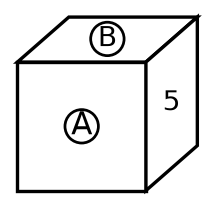
A cube has six numbers marked 1, 2, 3, 4, 5 and 6 on its faces. Three views of the cube are shown below:
What possible number can exist on the two faces marked (A) and (B), respectively on the cube?
Answer (a) & explanation
1. Find what is opposite 6. In the views, 6 sits next to 1, 4 (view 1) and 5, 3 (view 3). The only number never beside 6 is 2, so 2 is opposite 6.
2. Take view 3 (front 5, top 3, right 6) and give the cube a quarter turn so that 5 moves to the right side.
3. The top stays 3. The face that comes to the front is the one that was on the left, which is opposite 6, that is, 2.
4. So A = 2 and B = 3: (a).
Answer as per the official UPSC answer key.
Seven men, A, B, C, D, E, F and G are standing in a queue in that order. Each one is wearing a cap of a different colour like violet, indigo, blue, green, yellow, orange and red. D is able to see in front of him green and blue, but not violet. E can see violet and yellow, but not red. G can see caps of all colours other than orange. If E is wearing an indigo coloured cap, then the colour of the cap worn by F is
Answer (c) & explanation
Red is correct (c). Step 1: G, last in the queue, sees everyone but cannot see orange, so G wears orange. Step 2: D sees green and blue in front (A, B, C) but not violet. E sees violet and yellow but not red. So violet is on D, and A, B, C wear green, blue and yellow. Step 3: E wears indigo (given). The only colour left is red, so F wears red. Check: E cannot see red because F is behind him. So (a), (b) and (d) fail.
Tip: in queue questions, a person sees only those in front. A colour someone cannot see is either his own or behind him.
Answer as per the official UPSC answer key.
A sum of Rs. 700 has to be used to give seven cash prizes to the students of a school for their overall academic performance. If each prize is Rs. 20 less than its preceding prize, then what is the least value of the prize?
Answer (b) & explanation
Rs. 40 is correct (b). Step 1: the seven prizes fall in equal steps of Rs. 20, so they form an arithmetic series. In such a series, the middle (4th) prize equals the average: 700 ÷ 7 = Rs. 100. Step 2: the smallest prize is three steps below the middle: 100 − 3 × 20 = Rs. 40. Step 3: check: 160 + 140 + 120 + 100 + 80 + 60 + 40 = 700. So (a), (c) and (d) fail.
Tip: for an odd number of equally spaced values, the middle value is the average. This avoids writing equations. With an even count, the average lies halfway between the two middle values.
Answer as per the official UPSC answer key.
Consider the following statements:
- 1. A primary group is relatively smaller in size.
- 2. Intimacy is an essential characteristic of a primary group.
- 3. A family may be an example of a primary group.
In the light of the above statements, which one of the following is true?
Answer (d) & explanation
(d) is correct. Step 1: statement 2 says intimacy is essential to a primary group. So members of every primary group know each other intimately: (d) follows. Step 2: (a) is wrong: statement 3 says a family 'may be' an example of a primary group, not that all families are. (b) reverses this: nothing says every primary group is a family. Step 3: (c) is wrong: statement 1 says primary groups are relatively small, but a small group need not be primary; without intimacy, it is not. So (a), (b) and (c) fail.
Tip: 'essential characteristic' means every member of the category has it; that gives a safe 'all' conclusion. 'May be' and 'relatively' never do.
Answer as per the official UPSC answer key.
Read the passage
The law in many parts of the world increasingly restricts the discharge of agricultural slurry into watercourses. The simplest and often the most economically sound practice returns the material to the land as semisolid manure or as sprayed slurry. This dilutes its concentration in the environment to what might have occurred in a more primitive and sustainable type of agriculture and converts pollutant into fertilizer. Soil microorganisms decompose the organic components of sewage and slurry and most of the mineral nutrients become available to be absorbed again by the vegetation.
The excess input of nutrients, both nitrogen and phosphorus — based, from agricultural runoff (and human sewage) has caused many ‘healthy’ oligotrophic lakes (low nutrient concentrations, low plant productivity with abundant water weeds, and clear water) to change to eutrophic condition where high nutrient inputs lead to high phytoplankton productivity (sometimes dominated by bloom-forming toxic species). This makes the water turbid, eliminates large plants and, in the worst situations, leads to anoxia and fish kills; so called cultural eutrophication. Thus, important ecosystem services are lost, including the provisioning service of wild-caught fish and the cultural services associated with recreation.
The process of cultural eutrophication of lakes has been understood for some time. But only recently did scientists notice huge ‘dead zones’ in the oceans near river outlets, particularly those draining large catchment areas such as the Mississippi in North America and the Yangtze in China. The nutrient-enriched water flows through streams, rivers and lakes, and eventually to the estuary and ocean where the ecological impact may be huge, killing virtually all invertebrates and fish in areas up to 70,000 km² in extent. More than 150 sea areas worldwide are now regularly starved of oxygen as a result of decomposition of algal blooms, fuelled particularly by nitrogen from agricultural runoff of fertilizers and sewage from large cities. Oceanic dead zones are typically associated with industrialized nations and usually lie off countries that subsidize their agriculture, encouraging farmers to increase productivity and use more fertilizer.
What is the central theme of this passage ?
Answer (c) & explanation
(c) is correct. Step 1: the passage begins with laws on agricultural slurry, then explains how nutrient runoff causes eutrophication of lakes and huge 'dead zones' in the oceans. The common thread is that improper disposal of farm waste damages aquatic ecosystems: (c). Step 2: (a) is wrong: legislation is only mentioned in the first sentence; it is not the theme. Step 3: (b) and (d) are too sweeping: the passage does not blame all of modern agriculture, nor say chemical fertilizers are undesirable in themselves; it even recommends turning slurry into fertilizer. So (a), (b) and (d) fail.
Tip: the central theme should cover the whole passage, not only one sentence, and should not go further than the passage does.
Answer as per the official UPSC answer key.
Read the passage
A stout old lady was walking with her basket down the middle of a street in Petrograd to the great confusion of the traffic and no small peril to herself. It was pointed out to her that the pavement was the place for foot-passengers, but she replied, “I’m going to walk where I like. We’ve got liberty now.” It did not occur to the dear lady that if liberty entitled the foot-passenger to walk down the middle of the road it also entitled the taxi-driver to drive on the pavement, and that the end of such liberty would be universal chaos. Everything would be getting in everybody else’s way and nobody would get anywhere. Individual liberty would have become social anarchy.
The lady refused to move from the middle of the street because
Answer (b) & explanation
(b) is correct. Step 1: she replied, 'I'm going to walk where I like. We've got liberty now.' She believed her new freedom entitled her to do whatever she liked: (b). Step 2: (a) is wrong: she was in danger, but the passage does not say she refused because she was not afraid. Step 3: (c) is wrong: she never says she dislikes the pavement. (d) is wrong: it was the traffic that was confused, not her. So (a), (c) and (d) fail.
Tip: when a character's own words explain the action, use them. Note that 'confusion' in the passage belongs to the traffic, a classic word-swap trap.
Answer as per the official UPSC answer key.
Directions for the following 3 (three) items: Examine carefully the following statements and answer the three items that follow:
Out of four friends A, B, C and D,
A and B play football and cricket,
B and C play cricket and hockey,
A and D play basketball and football,
C and D play hockey and basketball.
Who does not play hockey?
Answer (d) & explanation
A is correct (d). Step 1: each pair plays two games, so build a list for each friend. A: football, cricket (with B), basketball, football (with D) = football, cricket, basketball. Step 2: B: football, cricket, hockey. C: cricket, hockey, basketball. D: basketball, football, hockey. Step 3: B, C and D all play hockey; only A does not. So (a), (b) and (c) fail.
Tip: turn pair statements into one list per person before answering. A small table of friends against games, with ticks, makes all three linked questions quick and avoids missing a game.
Answer as per the official UPSC answer key.
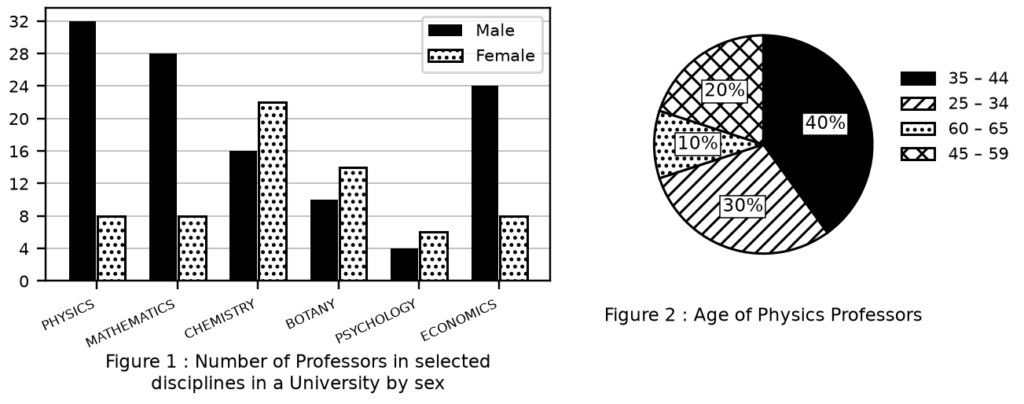
Direction for the following 5 (five) items: Study the two figures given below and answer the five items that follow:
How many Physics professors belong to the age group 35 – 44?
Answer (b) & explanation
16 is correct (b). Step 1: from Figure 1, Physics has 32 men + 8 women = 40 professors. Step 2: Figure 2 shows that 40% of Physics professors are in the age group 35–44. Step 3: 40% of 40 = 0.4 × 40 = 16. So (a), (c) and (d) fail.
Tip: in data questions, first get the total for the group (here all Physics professors), then apply the percentage. Write down the totals for each subject once at the start; the next four questions use the same figures. A quick check: 40% of 40 is the same as 40% × 40 = 16, as 10% is 4.
Answer as per the official UPSC answer key.
There are some balls of red, green and yellow colour lying on a table. There are as many red balls as there are yellow balls. There are twice as many yellow balls as there are green ones. The number of red balls
Answer (b) & explanation
'Double the number of green balls' is correct (b). Step 1: let the green balls be g. Yellow balls are twice the green, so yellow = 2g. Red balls equal yellow, so red = 2g. Step 2: so red is double the green balls: (b). Step 3: (a) says red = yellow + green = 3g, but red is 2g. (c) says red = yellow − green = g, but red is 2g. (d) is wrong because the relationship can be fixed even without the actual numbers. So (a), (c) and (d) fail.
Tip: when only relations are given, call the smallest group x and express the others in terms of it. 'Cannot be ascertained' is wrong whenever the ratios are fully fixed.
(d) is tempting because no number is given, but a ratio is enough here.
Answer as per the official UPSC answer key.
Out of 120 applications for a post, 70 are male and 80 have a driver's license. What is the ratio between the minimum to maximum number of males having driver's license?
Answer (c) & explanation
3 to 7 is correct (c). Step 1: the maximum number of licensed males is when all 70 males have a licence: 70 (there are 80 licences, enough). Step 2: the minimum is when overlap is as small as possible: 70 males + 80 licence-holders = 150, but there are only 120 people, so at least 150 − 120 = 30 must be both. Step 3: minimum : maximum = 30 : 70 = 3 : 7. So (a), (b) and (d) fail.
Tip: for two groups in a fixed total, maximum overlap = the smaller group; minimum overlap = sum of groups − total (or zero if that is negative). Draw two circles inside a box to see it.
Answer as per the official UPSC answer key.
Four friends, A, B, C and D distribute some money among themselves in such a manner that A gets one less than B, C gets 5 more than D, D gets 3 more than B. Who gets the smallest amount?
Answer (a) & explanation
A is correct (a). Step 1: let B get x. A gets one less than B, so A = x − 1. D gets 3 more than B, so D = x + 3. C gets 5 more than D, so C = x + 8. Step 2: put them in order: C (x + 8) > D (x + 3) > B (x) > A (x − 1). Step 3: A gets the smallest amount. B is just above A, D is in the middle and C gets the most, so (b), (c) and (d) fail.
Tip: when everything is described relative to others, give one person the value x and write everyone else in terms of x. The order then becomes clear without knowing the actual money.
Answer as per the official UPSC answer key.
Read the passage
The miseries of the world cannot be cured by physical help only. Until man’s nature changes, his physical needs will always arise, and miseries will always be felt, and no amount of physical help will remove them completely. The only solution of the problem is to make mankind pure. Ignorance is the mother of evil and of all the misery we see. Let men have light, let them be pure and spiritually strong and educated; then alone will misery cease in the world. We may convert every house in the country into a charitable asylum, we may fill the land with hospitals, but human misery will continue until man’s character changes.
According to the passage, which of the following statements is most likely to be true as the reason for man’s miseries ?
Answer (b) & explanation
(b) is correct. Step 1: the passage says 'human misery will continue until man's character changes' and 'Until man's nature changes… miseries will always be felt'. So the root of misery is man's failure to change his character: (b). Step 2: (a) is wrong: poor economic and social conditions are not called the cause; the author says even hospitals and charity everywhere will not end misery. Step 3: (c) is wrong: physical help cannot cure misery, so its absence is not the cause. (d) is wrong: changing social structure is never mentioned. So (a), (c) and (d) fail.
Tip: find the sentence the author repeats in different words; the repeated idea is usually the main reason he gives.
Answer as per the official UPSC answer key.
Read the passage
A stout old lady was walking with her basket down the middle of a street in Petrograd to the great confusion of the traffic and no small peril to herself. It was pointed out to her that the pavement was the place for foot-passengers, but she replied, “I’m going to walk where I like. We’ve got liberty now.” It did not occur to the dear lady that if liberty entitled the foot-passenger to walk down the middle of the road it also entitled the taxi-driver to drive on the pavement, and that the end of such liberty would be universal chaos. Everything would be getting in everybody else’s way and nobody would get anywhere. Individual liberty would have become social anarchy.
The old lady failed to realise that
Answer (b) & explanation
(b) is correct. Step 1: the author says she did not realise that if liberty let a walker use the middle of the road, it also let a taxi drive on the pavement, ending in 'universal chaos'. So she failed to see that liberty is not unlimited: (b). Step 2: (a) is wrong: she was free; the point is that freedom has limits, not that she lacked it. Step 3: (c) is wrong: her age is irrelevant. (d) is wrong: the author never says roads are for vehicles only. So (a), (c) and (d) fail.
Tip: this is a passage about the limits of rights: one person's freedom ends where it harms others. The answer often has words like 'not unlimited'.
Answer as per the official UPSC answer key.
(Same information as the question above.)
Who plays football, basketball and hockey?
Answer (a) & explanation
D is correct (a). Step 1: from the pair statements, D plays basketball and football (with A) and hockey and basketball (with C). So D plays football, basketball and hockey. Step 2: C plays cricket, hockey and basketball, but not football. Step 3: B plays football, cricket and hockey, but not basketball. A plays football, cricket and basketball, but not hockey. So only D plays all three named games, and (b), (c) and (d) fail.
Tip: the friends' lists: A — football, cricket, basketball; B — football, cricket, hockey; C — cricket, hockey, basketball; D — football, basketball, hockey. Each friend misses exactly one game, which is a quick check that your table is right.
Answer as per the official UPSC answer key.
(Same figures as the question above.)
Which one of the following disciplines has the highest ratio of males to females?
Answer (a) & explanation
Physics is correct (a). Step 1: work out men ÷ women for each subject. Physics: 32 ÷ 8 = 4. Mathematics: 28 ÷ 8 = 3.5. Step 2: Chemistry: 16 ÷ 22, which is less than 1 (more women than men). Economics: 24 ÷ 8 = 3. Step 3: the highest ratio is Physics (4). So (b), (c) and (d) fail.
Tip: a 'ratio of males to females' is men divided by women. When the number of women is the same in several subjects (8 here), simply compare the number of men. Physics has the most men among those, so it wins quickly.
Answer as per the official UPSC answer key.