
CSAT (Paper II): previous-year questions
1280 real UPSC Prelims questions (2011–2026) with the official answer and a clear explanation. 400 of them came in the last five papers.
How often UPSC asks this
Questions per year, counted from the official papers.
Subtopics
Arrangements, ranking, ordering and puzzles
142 questions
Clocks and calendars
5 questions
Coding-decoding, series, patterns, cubes, dice and visual reasoning
110 questions
Communication, interpersonal skills and decision-making
10 questions
Counting, permutations, combinations and probability
1 questions
Directions, blood relations and Venn diagrams
60 questions
General English: grammar, vocabulary and comprehension
20 questions
General Hindi: grammar, vocabulary, dialects and comprehension
25 questions
Geometry and mensuration
26 questions
Number system and basic algebra (divisibility, HCF/LCM, remainders, digits, equations)
196 questions
Percentages, profit and loss, discount, simple and compound interest
47 questions
Ratio, proportion, averages, mixtures and alligation
47 questions
Syllogisms, statements and conclusions, assumptions and arguments
89 questions
Time and work; pipes and cisterns
2 questions
Time, speed and distance; trains, boats and streams; races
48 questions
Attempt the questions
Newest papers first. Tap an option; the answer and the reason appear instantly.
Consider the following statements:
- 1. All artists are whimsical.
- 2. Some artists are drug addicts.
- 3. Frustrated people are prone to become drug addicts.
From the above three statements it may be concluded that
Answer (b) & explanation
'Some drug addicts are whimsical' is correct (b). Step 1: statement 1 says all artists are whimsical. Statement 2 says some artists are drug addicts. Step 2: those artists who are drug addicts are still artists, so they are whimsical. Therefore at least some drug addicts are whimsical. Step 3: (a) does not follow: the statements never say artists are frustrated. (c) fails: being 'prone to' addiction is not the same as all frustrated people being addicts. (d) fails: nothing links whimsical people to frustration. So (a), (c) and (d) fail.
Tip: draw circles: put the 'artists' circle fully inside 'whimsical', then let 'drug addicts' overlap artists. The overlap sits inside 'whimsical'.
Answer as per the official UPSC answer key.
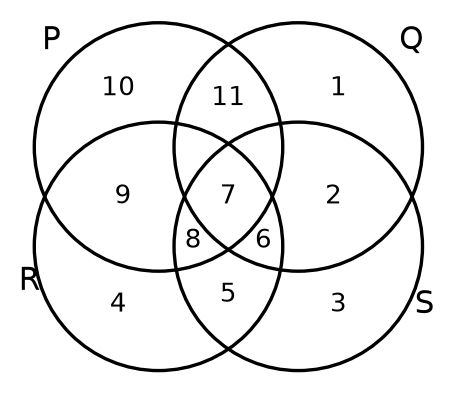
In the above figure, circle P represents hardworking people, circle Q represents intelligent people, circle R represents truthful people, and circle S represents honest people. Which region represents the people who are intelligent, honest and truthful but not hardworking?
Answer (a) & explanation
Region 6 is correct (a). Step 1: we need people who are intelligent (Q), truthful (R) and honest (S) but not hardworking (outside P). So the region must lie inside Q, R and S, and outside P. Step 2: region 7 is inside all four circles, so it includes hardworking people: wrong. Region 8 is inside P: wrong. Region 11 is only in P and Q: wrong. Step 3: region 6 is inside Q, R and S and outside P. So (b), (c) and (d) fail.
Tip: turn the description into 'inside' and 'outside' lists first. Then test each region number against both lists; one wrong circle rules it out.
Answer as per the official UPSC answer key.
As a citizen you have some work with a government department. The official calls you again and again; and without directly asking you, sends out feelers for a bribe. You want to get your work done. You would...
Answer (b) & explanation
(b) and (c) are both correct (UPSC accepted both; no negative marking). Step 1: the official is hinting at a bribe but has not asked directly. You want your work done honestly. Step 2: (b) ignoring the hints and pressing your application, or (c) asking a senior officer for help, both refuse the bribe and keep your case moving. Step 3: (a) paying a bribe is a crime under the Prevention of Corruption Act. (d) a formal complaint based only on hints is hard to prove and may delay your work.
Tip: for these interpersonal items, pick the response that is lawful, honest and fixes the real problem through proper channels. Avoid options that give in, run away from duty or act without hearing the facts.
Answer as per the official UPSC answer key.
Examine the following statements:
- 1. Rama scored more than Rani.
- 2. Rani scored less than Ratna.
- 3. Ratna scored more than Rama.
- 4. Padma scored more than Rama but less than Ratna.
Who scored the highest?
Answer (d) & explanation
Ratna is correct (d). Step 1: statement 1 gives Rama > Rani. Statement 3 gives Ratna > Rama. Statement 4 puts Padma between them: Ratna > Padma > Rama. Step 2: put them in one line: Ratna > Padma > Rama > Rani. Statement 2 (Rani < Ratna) agrees with this. Step 3: Ratna is at the top. Rama is third, Padma second and Rani last, so (a), (b) and (c) fail.
Tip: write each clue as a '>' sign and slot every new name into one single line. 'Scored less than' is just the same sign read the other way; turn all clues into 'more than' form so you do not mix up directions.
Answer as per the official UPSC answer key.
(Same information as the question above.)
Which lecture is the last one in the week?
Answer (c) & explanation
Mathematics is correct (c). Step 1: History is fixed on Tuesday. English, Economics and Mathematics must run on three days in a row in that order, and the only such free days are Wednesday, Thursday and Friday. Step 2: so Mathematics, the last of the three, falls on Friday. Statistics fills Monday. Step 3: the week is Mon Statistics, Tue History, Wed English, Thu Economics, Fri Mathematics. Friday is the last day, so the last lecture is Mathematics. History, English and Economics are earlier in the week, so (a), (b) and (d) fail.
Tip: when three items must come in a row and one day is already taken, list the possible runs of free days. Often only one run fits.
Answer as per the official UPSC answer key.
Read the passage
Chemical pesticides lose their role in sustainable agriculture if the pests evolve resistance. The evolution of pesticide resistance is simply natural selection in action. It is almost certain to occur when vast numbers of a genetically variable population are killed. One or a few individuals may be unusually resistant (perhaps because they possess an enzyme that can detoxify the pesticide). If the pesticide is applied repeatedly, each successive generation of the pest will contain a larger proportion of resistant individuals. Pests typically have a high intrinsic rate of reproduction, and so a few individuals in one generation may give rise to hundreds or thousands in the next, and resistance spreads very rapidly in a population.
This problem was often ignored in the past, even though the first case of DDT (dichlorodiphenyltrichloroethane) resistance was reported as early as 1946. There is exponential increase in the numbers of invertebrates that have evolved resistance and in the number of pesticides against which resistance has evolved. Resistance has been recorded in every family of arthropod pests (including dipterans such as mosquitoes and house flies, as well as beetles, moths, wasps, fleas, lice and mites) as well as in weeds and plant pathogens. Take the Alabama leafworm, a moth pest of cotton, as an example. It has developed resistance in one or more regions of the world to aldrin, DDT, dieldrin, endrin, lindane and toxaphene.
If chemical pesticides brought nothing but problems, — if their use was intrinsically and acutely unsustainable — then they would already have fallen out of widespread use. This has not happened. Instead, their rate of production has increased rapidly. The ratio of cost to benefit for the individual agricultural producer has remained in favour of pesticide use. In the USA, insecticides have been estimated to benefit the agricultural products to the tune of around $5 for every $1 spent.
Moreover, in many poorer countries, the prospect of imminent mass starvation, or of an epidemic disease, are so frightening that the social and health costs of using pesticides have to be ignored. In general the use of pesticides is justified by objective measures such as ‘lives saved’, ‘economic efficiency of food production’ and ‘total food produced’. In these very fundamental senses, their use may be described as sustainable. In practice, sustainability depends on continually developing new pesticides that keep at least one step ahead of the pests — pesticides that are less persistent, biodegradable and more accurately targeted at the pests.
Though the problems associated with the use of chemical pesticides is known for a long time, their widespread use has not waned. Why ?
Answer (d) & explanation
None of these is correct (d). Step 1: the passage gives the real reason pesticide use has not fallen: the cost-to-benefit ratio 'has remained in favour of pesticide use' (about $5 of benefit for $1 spent in the USA). None of the options says this. Step 2: (a) the passage never says alternatives do not exist at all. (b) is false: it speaks of 'continually developing new pesticides'. Step 3: (c) is wrong because the passage only hopes for future pesticides that are 'biodegradable'; it does not say present ones are. So (a), (b) and (c) fail.
Tip: when the true reason is missing from the options, 'none of the above' is a real choice. Check each option against the text before ruling it out.
Answer as per the official UPSC answer key.
Read the passage
The need for Competition Law becomes more evident when foreign direct investment (FDI) is liberalised. The impact of FDI is not always pro-competitive. Very often FDI takes the form of a foreign corporation acquiring a domestic enterprise or establishing a joint venture with one. By making such an acquisition the foreign investor may substantially lessen competition and gain a dominant position in the relevant market, thus charging higher prices. Another scenario is where the affiliates of two separate multinational companies (MNCs) have been established in competition with one another in a particular developing economy, following the liberalisation of FDI. Subsequently, the parent companies overseas merge. With the affiliates no longer remaining independent, competition in the host country may be virtually eliminated and the prices of the products may be artificially inflated. Most of these adverse consequences of mergers and acquisitions by MNCs can be avoided if an effective competition law is in place. Also, an economy that has implemented an effective competition law is in a better position to attract FDI than one that has not. This is not just because most MNCs are expected to be accustomed to the operation of such a law in their home countries and know how to deal with such concerns but also that MNCs expect competition authorities to ensure a level playing field between domestic and foreign firms.
What is the inference from this passage ?
Answer (c) & explanation
(c) is correct. Step 1: the passage says most harms of MNC mergers 'can be avoided if an effective competition law is in place', and that MNCs expect competition authorities to 'ensure a level playing field between domestic and foreign firms'. Step 2: (a) is wrong because of 'always': the passage only describes situations where foreign firms may dominate. Step 3: (b) is wrong: the passage does not oppose mergers as such; it wants them checked by competition law. (d) is wrong: whether FDI is essential for growth is never discussed. So (a), (b) and (d) fail.
Tip: the best inference usually echoes the passage's conclusion (here, the value of competition law). Options with 'always' or new topics are traps.
Answer as per the official UPSC answer key.
Read the passage
We started pitching the highest camp that has ever been made. Everything took five times as long as it would have taken in a place where there was enough air to breathe; but at last we got the tent up, and when we crawled in, it was not too bad. There was only a light wind, and inside it was not too cold for us to take off our gloves. At night most climbers take off their boots; but I prefer to keep them on. Hillary, on the other hand, took his off and laid them next to his sleeping bag.
They took a long time to finish the work because
Answer (b) & explanation
(b) is correct. Step 1: the passage says everything 'took five times as long as it would have taken in a place where there was enough air to breathe'. So the thin air at that height slowed them down. Step 2: (a) is wrong: tiredness is not given as the reason. Step 3: (c) is wrong: the passage says inside 'it was not too cold'. (d) is wrong: darkness is never mentioned. So (a), (c) and (d) fail.
Tip: in 'because' questions, find the sentence that gives the cause directly. Here the comparison with 'a place where there was enough air' tells you the cause was lack of air. Remember: at great heights air is thin and every action takes longer.
Answer as per the official UPSC answer key.
Examine the following statements:
- 1. Either A and B are of the same age or A is older than B.
- 2. Either C and D are of the same age or D is older than C.
- 3. B is older than C.
Which one of the following conclusions can be drawn from the above statements?
Answer (d) & explanation
'A is older than C' is correct (d). Step 1: statement 1 means A is the same age as B or older: A ≥ B. Statement 2 means D ≥ C. Statement 3 says B > C. Step 2: join them: A ≥ B > C, so A is definitely older than C (d). Step 3: (a) fails because A and B may be the same age. (b) fails because nothing links B and D. (c) fails because C and D may be the same age. So only (d) is certain.
Tip: turn 'either the same age or older' into the sign ≥. Then chain the signs. A conclusion is certain only if every link holds; one 'may be equal' breaks a strict 'older than'.
Answer as per the official UPSC answer key.
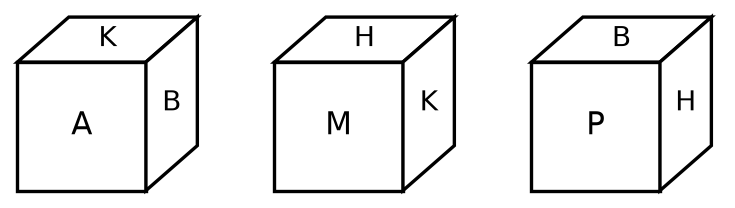
Three views of a cube following a particular motion are given below:
What is the letter opposite to A?
Answer (a) & explanation
H is correct (a). Step 1: letters seen together in one view are neighbours, so they cannot be opposite each other. Step 2: view 2 shows H with M and K. View 3 shows H with B and P. So H touches K, M, B and P. Step 3: a face touches four faces and is opposite just one. The only letter H never touches is A, so H is opposite A. B, P and M all touch H's group of neighbours, so (b), (c) and (d) fail.
Tip: list each letter's neighbours from all the views. A cube face has exactly four neighbours; the one letter left over is the opposite face.
Answer as per the official UPSC answer key.
Read the passage
Invasions of exotic species into new geographic areas sometimes occur naturally and without human agency. However, human actions have increased this trickle to a flood. Human-caused introductions may occur either accidentally as a consequence of human transport, or intentionally but illegally to serve some private purpose or legitimately to procure some hoped-for public benefit by bringing a pest under control, producing new agricultural products or providing novel recreational opportunities. Many introduced species are assimilated into communities without much obvious effect. However, some have been responsible for dramatic changes to native species and natural communities. For example, the accidental introduction of the brown tree snake Boiga irregularis into Guam, an island in the Pacific, has through nest predation reduced 10 endemic forest bird species to the point of extinction.
One of the major reasons for the world’s great biodiversity is the occurrence of centers of endemism so that similar habitats in different parts of the world are occupied by different groups of species that happen to have evolved there. If every species naturally had access to everywhere on the globe, we might expect a relatively small number of successful species to become dominant in each biome. The extent to which this homogenization can happen naturally is restricted by the limited powers of dispersal of most species in the face of the physical barriers that exist to dispersal. By virtue of the transport opportunities offered by humans, these barriers have been breached by an ever-increasing number of exotic species. The effects of introductions have been to convert a hugely diverse range of local community compositions into something much more homogeneous.
It would be wrong, however, to conclude that introducing species to a region will inevitably cause a decline in species richness there. For example, there are numerous species of plants, invertebrates and vertebrates found in continental Europe but absent from the British Isles (many because they have so far failed to recolonize after the last glaciations). Their introduction would be likely to augment British biodiversity. The significant detrimental effect noted above arises where aggressive species provide a novel challenge to endemic biotas ill-equipped to deal with them.
With reference to the passage, which of the following statements is correct ?
Answer (d) & explanation
None of the statements is correct (d). Step 1: (a) says introductions always reduce biodiversity. The passage says this is 'wrong' and that bringing continental species to Britain would 'augment British biodiversity'. Step 2: (b) says introduced species have always greatly changed native systems. The passage says 'many introduced species are assimilated without much obvious effect'. Step 3: (c) says man is the only cause of homogenization. The passage says invasions also 'occur naturally', even if humans turned the trickle into a flood. So (a), (b) and (c) all fail.
Tip: words like 'always' and 'only' in options are warning signs. One counter-example in the passage is enough to reject them.
Answer as per the official UPSC answer key.
(Same information as the question above.)
Which lecture is scheduled on Wednesday?
Answer (c) & explanation
English is correct (c). Step 1: History is on Tuesday (only day the faculty is free). Step 2: the block English → Economics → Mathematics needs three days in a row; only Wed–Thu–Fri are free in a row, and this also keeps Economics off Tuesday. Step 3: so English is on Wednesday, Economics Thursday, Mathematics Friday, and Statistics Monday. Statistics is Monday, Economics Thursday and History Tuesday, so (a), (b) and (d) fail.
Tip: check your schedule against every clue once before answering. Here: Economics not on Tuesday (✓ Thursday), History Tuesday (✓), English just before Economics (✓), Mathematics just after Economics (✓). One check protects all five linked answers.
Answer as per the official UPSC answer key.
Read the passage
Chemical pesticides lose their role in sustainable agriculture if the pests evolve resistance. The evolution of pesticide resistance is simply natural selection in action. It is almost certain to occur when vast numbers of a genetically variable population are killed. One or a few individuals may be unusually resistant (perhaps because they possess an enzyme that can detoxify the pesticide). If the pesticide is applied repeatedly, each successive generation of the pest will contain a larger proportion of resistant individuals. Pests typically have a high intrinsic rate of reproduction, and so a few individuals in one generation may give rise to hundreds or thousands in the next, and resistance spreads very rapidly in a population.
This problem was often ignored in the past, even though the first case of DDT (dichlorodiphenyltrichloroethane) resistance was reported as early as 1946. There is exponential increase in the numbers of invertebrates that have evolved resistance and in the number of pesticides against which resistance has evolved. Resistance has been recorded in every family of arthropod pests (including dipterans such as mosquitoes and house flies, as well as beetles, moths, wasps, fleas, lice and mites) as well as in weeds and plant pathogens. Take the Alabama leafworm, a moth pest of cotton, as an example. It has developed resistance in one or more regions of the world to aldrin, DDT, dieldrin, endrin, lindane and toxaphene.
If chemical pesticides brought nothing but problems, — if their use was intrinsically and acutely unsustainable — then they would already have fallen out of widespread use. This has not happened. Instead, their rate of production has increased rapidly. The ratio of cost to benefit for the individual agricultural producer has remained in favour of pesticide use. In the USA, insecticides have been estimated to benefit the agricultural products to the tune of around $5 for every $1 spent.
Moreover, in many poorer countries, the prospect of imminent mass starvation, or of an epidemic disease, are so frightening that the social and health costs of using pesticides have to be ignored. In general the use of pesticides is justified by objective measures such as ‘lives saved’, ‘economic efficiency of food production’ and ‘total food produced’. In these very fundamental senses, their use may be described as sustainable. In practice, sustainability depends on continually developing new pesticides that keep at least one step ahead of the pests — pesticides that are less persistent, biodegradable and more accurately targeted at the pests.
How do pesticides act as agents for the selection of resistant individuals in any pest population ?
- 1. It is possible that in a pest population the individuals will behave differently due to their genetic makeup.
- 2. Pests do possess the ability to detoxify the pesticides.
- 3. Evolution of pesticide resistance is equally distributed in pest population.
Which of the statements given above is/are correct ?
Answer (b) & explanation
Statements 1 and 2 are correct (b). Step 1: the passage speaks of a 'genetically variable population', so individuals respond differently because of their genes: 1 is right. Step 2: it says a few may be resistant 'perhaps because they possess an enzyme that can detoxify the pesticide': 2 is right. Step 3: statement 3 says resistance is equally distributed. The passage says it begins in 'one or a few individuals' and spreads over generations, so it is unequal at first. So 3 is wrong, and (a), (c) and (d) fail.
Tip: selection works only because individuals differ. Any statement saying everyone is the same ('equally distributed') goes against the whole idea of selection.
Answer as per the official UPSC answer key.
Examine the following statements:
- 1. I watch TV only if I am bored.
- 2. I am never bored when I have my brother's company.
- 3. Whenever I go to the theatre, I take my brother along.
Which one of the following conclusions is valid in the context of the above statements?
Answer (d) & explanation
(d) is correct. Step 1: 'I watch TV only if I am bored' means: if I watch TV, I am bored. Its valid flip (contrapositive) is: if I am not bored, I do not watch TV. That is (d). Step 2: (a) reverses the rule; being bored does not force me to watch TV. Step 3: (b) is wrong: the statements say I am never bored with my brother, not that boredom makes me seek him. (c) is wrong: being without my brother does not prove I am bored, and even boredom does not force TV. So (a), (b) and (c) fail.
Tip: 'A only if B' means 'if A then B'. The safe conclusion is 'if not B then not A'; never reverse it to 'if B then A'.
'only if' puts the condition after the arrow: P only if Q means P → Q.
Answer as per the official UPSC answer key.
Read the passage
We started pitching the highest camp that has ever been made. Everything took five times as long as it would have taken in a place where there was enough air to breathe; but at last we got the tent up, and when we crawled in, it was not too bad. There was only a light wind, and inside it was not too cold for us to take off our gloves. At night most climbers take off their boots; but I prefer to keep them on. Hillary, on the other hand, took his off and laid them next to his sleeping bag.
When they crawled into the tent
Answer (a) & explanation
(a) is correct. Step 1: the passage says 'inside it was not too cold for us to take off our gloves'. So they took their gloves off because it was not very cold. Step 2: (b) and (c) are wrong: both say it was very cold, the opposite of the text. Step 3: (d) is wrong: it says they did not take off their gloves, which reverses the action. So (b), (c) and (d) fail.
Tip: the phrase 'not too cold to do X' means it was warm enough to do X. Options here change one or two small parts (the temperature or the action). Check both parts against the sentence before choosing.
Answer as per the official UPSC answer key.
Examine the following statements:
- 1. Only those who have a pair of binoculars can become the members of the birdwatcher's club.
- 2. Some members of the birdwatcher's club have cameras.
- 3. Those members who have cameras can take part in photo-contests.
Which of the following conclusions can be drawn from the above statements?
Answer (b) & explanation
'All members have binoculars' is correct (b). Step 1: 'Only those who have binoculars can become members' means every member must have binoculars. So (b) follows directly. Step 2: (a) reverses it: having binoculars does not make you a member; it only makes you eligible. Step 3: (c) fails: statement 3 says members with cameras can take part in photo-contests, but it never says only members take part; outsiders may join too. Since (b) follows, (d) also fails.
Tip: 'Only X can be Y' means 'every Y is X', not 'every X is Y'. Turning the sentence round is the most common trap in these questions.
Answer as per the official UPSC answer key.
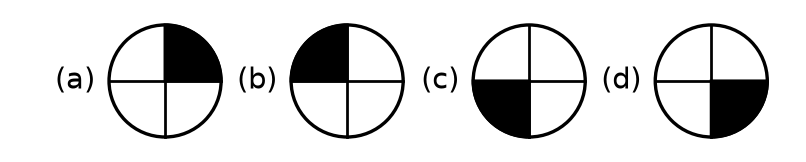
Which one of the figures shown below occupies the blank space (?) in the matrix given above?
Answer (d) & explanation
Figure (d) is correct. Step 1: in each row the first and last circles are the same. Step 2: the middle circle has its black quarter in the opposite corner. Row 1: the ends have top-right black, the middle has bottom-left black. Row 3: the ends have bottom-right black, the middle has top-left black. Step 3: row 2's ends have the top-left quarter black, so the middle must have the bottom-right quarter black. That is (d). So (a), (b) and (c) fail.
Tip: in matrix figures, check rows first, then columns. Look for 'same at both ends' and 'opposite in the middle' patterns; they are very common in UPSC CSAT.
Answer as per the official UPSC answer key.
Read the passage
Invasions of exotic species into new geographic areas sometimes occur naturally and without human agency. However, human actions have increased this trickle to a flood. Human-caused introductions may occur either accidentally as a consequence of human transport, or intentionally but illegally to serve some private purpose or legitimately to procure some hoped-for public benefit by bringing a pest under control, producing new agricultural products or providing novel recreational opportunities. Many introduced species are assimilated into communities without much obvious effect. However, some have been responsible for dramatic changes to native species and natural communities. For example, the accidental introduction of the brown tree snake Boiga irregularis into Guam, an island in the Pacific, has through nest predation reduced 10 endemic forest bird species to the point of extinction.
One of the major reasons for the world’s great biodiversity is the occurrence of centers of endemism so that similar habitats in different parts of the world are occupied by different groups of species that happen to have evolved there. If every species naturally had access to everywhere on the globe, we might expect a relatively small number of successful species to become dominant in each biome. The extent to which this homogenization can happen naturally is restricted by the limited powers of dispersal of most species in the face of the physical barriers that exist to dispersal. By virtue of the transport opportunities offered by humans, these barriers have been breached by an ever-increasing number of exotic species. The effects of introductions have been to convert a hugely diverse range of local community compositions into something much more homogeneous.
It would be wrong, however, to conclude that introducing species to a region will inevitably cause a decline in species richness there. For example, there are numerous species of plants, invertebrates and vertebrates found in continental Europe but absent from the British Isles (many because they have so far failed to recolonize after the last glaciations). Their introduction would be likely to augment British biodiversity. The significant detrimental effect noted above arises where aggressive species provide a novel challenge to endemic biotas ill-equipped to deal with them.
Why does man introduce exotic species into new geographical areas ?
- 1. To breed exotic species with local varieties.
- 2. To increase agricultural productivity.
- 3. For beautification and landscaping.
Which of the above statements is/are correct ?
Answer (d) & explanation
All three is the official key (d). Step 1: the passage lists reasons for deliberate introductions: controlling pests, 'producing new agricultural products' and 'providing novel recreational opportunities'. Step 2: new agricultural products fit raising farm productivity (2). Recreational uses are read broadly to cover beautification and landscaping (3). Step 3: UPSC also reads 'new agricultural products' as covering breeding with local varieties (1). Note: statement 1 is DOUBTFUL — breeding is never mentioned, so (b) '2 and 3 only' is arguable. UPSC's key, however, is (d).
Tip: when the passage gives a general reason ('new products'), UPSC sometimes accepts specific examples of it. Choose the key, but note where the text is thin.
Answer as per the official UPSC answer key.
(Same information as the question above.)
Which lecture is scheduled before the Mathematics lecture?
Answer (a) & explanation
Economics is correct (a). Step 1: the clue itself says Mathematics is scheduled 'immediately after the day of Economics'. Step 2: in the full week (Mon Statistics, Tue History, Wed English, Thu Economics, Fri Mathematics), Economics on Thursday comes just before Mathematics on Friday. Step 3: History (Tuesday), Statistics (Monday) and English (Wednesday) also come before Mathematics in the week, but not just before it. The question means the lecture immediately before, so (b), (c) and (d) fail.
Tip: some answers can be read straight from a clue. Before working the whole puzzle, check whether one clue already answers the question.
Answer as per the official UPSC answer key.
Read the passage
Chemical pesticides lose their role in sustainable agriculture if the pests evolve resistance. The evolution of pesticide resistance is simply natural selection in action. It is almost certain to occur when vast numbers of a genetically variable population are killed. One or a few individuals may be unusually resistant (perhaps because they possess an enzyme that can detoxify the pesticide). If the pesticide is applied repeatedly, each successive generation of the pest will contain a larger proportion of resistant individuals. Pests typically have a high intrinsic rate of reproduction, and so a few individuals in one generation may give rise to hundreds or thousands in the next, and resistance spreads very rapidly in a population.
This problem was often ignored in the past, even though the first case of DDT (dichlorodiphenyltrichloroethane) resistance was reported as early as 1946. There is exponential increase in the numbers of invertebrates that have evolved resistance and in the number of pesticides against which resistance has evolved. Resistance has been recorded in every family of arthropod pests (including dipterans such as mosquitoes and house flies, as well as beetles, moths, wasps, fleas, lice and mites) as well as in weeds and plant pathogens. Take the Alabama leafworm, a moth pest of cotton, as an example. It has developed resistance in one or more regions of the world to aldrin, DDT, dieldrin, endrin, lindane and toxaphene.
If chemical pesticides brought nothing but problems, — if their use was intrinsically and acutely unsustainable — then they would already have fallen out of widespread use. This has not happened. Instead, their rate of production has increased rapidly. The ratio of cost to benefit for the individual agricultural producer has remained in favour of pesticide use. In the USA, insecticides have been estimated to benefit the agricultural products to the tune of around $5 for every $1 spent.
Moreover, in many poorer countries, the prospect of imminent mass starvation, or of an epidemic disease, are so frightening that the social and health costs of using pesticides have to be ignored. In general the use of pesticides is justified by objective measures such as ‘lives saved’, ‘economic efficiency of food production’ and ‘total food produced’. In these very fundamental senses, their use may be described as sustainable. In practice, sustainability depends on continually developing new pesticides that keep at least one step ahead of the pests — pesticides that are less persistent, biodegradable and more accurately targeted at the pests.
Why is the use of chemical pesticides generally justified by giving the examples of poor and developing countries ?
- 1. Developed countries can afford to do away with use of pesticides by adapting to organic farming, but it is imperative for poor and developing countries to use chemical pesticides.
- 2. In poor and developing countries, the pesticide addresses the problem of epidemic diseases of crops and eases the food problem.
- 3. The social and health costs of pesticide use are generally ignored in poor and developing countries.
Which of the statements given above is/are correct ?
Answer (c) & explanation
Only statement 2 is correct (c). Step 1: the passage says in poorer countries 'the prospect of imminent mass starvation, or of an epidemic disease' is so frightening that pesticides are used. That is the justification: they ease food problems and disease: 2 is right. Step 2: statement 1 talks about organic farming in developed countries, which the passage never mentions. Step 3: statement 3 is a result of that fear (the costs 'have to be ignored'), not the reason for using pesticides. The question asks why use is justified, so 3 fails. Hence (a), (b) and (d) are wrong.
Tip: separate the reason from the consequence. A true fact from the passage can still be the wrong answer to a 'why' question.
Answer as per the official UPSC answer key.