
CSAT (Paper II): previous-year questions
1280 real UPSC Prelims questions (2011–2026) with the official answer and a clear explanation. 400 of them came in the last five papers.
How often UPSC asks this
Questions per year, counted from the official papers.
Subtopics
Arrangements, ranking, ordering and puzzles
142 questions
Clocks and calendars
5 questions
Coding-decoding, series, patterns, cubes, dice and visual reasoning
110 questions
Communication, interpersonal skills and decision-making
10 questions
Counting, permutations, combinations and probability
1 questions
Directions, blood relations and Venn diagrams
60 questions
General English: grammar, vocabulary and comprehension
20 questions
General Hindi: grammar, vocabulary, dialects and comprehension
25 questions
Geometry and mensuration
26 questions
Number system and basic algebra (divisibility, HCF/LCM, remainders, digits, equations)
196 questions
Percentages, profit and loss, discount, simple and compound interest
47 questions
Ratio, proportion, averages, mixtures and alligation
47 questions
Syllogisms, statements and conclusions, assumptions and arguments
89 questions
Time and work; pipes and cisterns
2 questions
Time, speed and distance; trains, boats and streams; races
48 questions
Attempt the questions
Newest papers first. Tap an option; the answer and the reason appear instantly.
Read the passage
Today’s developing economies use much less energy per capita than developed countries such as the United States did at similar incomes, showing the potential for lower-carbon growth. Adaptation and mitigation need to be integrated into a climate-smart development strategy that increases resilience, reduces the threat of further global warming, and improves development outcomes. Adaptation and mitigation measures can advance development, and prosperity can raise incomes and foster better institutions. A healthier population living in better-built houses and with access to bank loans and social security is better equipped to deal with a changing climate and its consequences. Advancing robust, resilient development policies that promote adaptation is needed today because changes in the climate, already begun, will increase even in the short term.
The spread of economic prosperity has always been intertwined with adaptation to changing ecological conditions. But as growth has altered the environment and as environmental change has accelerated, sustaining growth and adaptability demands greater capacity to understand our environment, generate new adaptive technologies and practices, and diffuse them widely. As economic historians have explained, much of humankind’s creative potential has been directed at adapting to the changing world. But adaptation cannot cope with all the impacts related to climate change, especially as larger changes unfold in the long term.
Countries cannot grow out of harm’s way fast enough to match the changing climate. And some growth strategies, whether driven by the government or the market, can also add to vulnerability — particularly if they overexploit natural resources. Under the Soviet development plan, irrigated cotton cultivation expanded in water-stressed Central Asia and led to the near disappearance of the Aral Sea, threatening the livelihoods of fishermen, herders and farmers. And clearing mangroves — the natural coastal buffers against storm surges — to make way for intensive farming or housing development, increases the physical vulnerability of coastal settlements, whether in Guinea or in Louisiana.
What does low-carbon growth imply in the present context ?
- 1. More emphasis on the use of renewable sources of energy.
- 2. Less emphasis on manufacturing sector and more emphasis on agricultural sector.
- 3. Switching over from monoculture practices to mixed farming.
- 4. Less demand for goods and services.
Select the correct answer using the codes given below :
Answer (a) & explanation
Only point 1 is correct (a). Step 1: the passage says developing economies use 'much less energy per capita' than rich countries did at similar incomes, 'showing the potential for lower-carbon growth'. Growing with less carbon means relying more on cleaner, renewable energy: 1 fits. Step 2: point 2 (less manufacturing, more farming) and point 3 (mixed farming instead of monoculture) are never discussed. Step 3: point 4 (less demand for goods and services) is wrong: low-carbon growth still means growing, not shrinking demand. So (b), (c) and (d) fail.
Tip: 'low-carbon growth' has two parts: keep growing, but emit less carbon. Reject any option that gives up growth itself.
Answer as per the official UPSC answer key.
Consider the following statements:
- 1. All X-brand cars parked here are white.
- 2. Some of them have radial tyres.
- 3. All X-brand cars manufactured after 1986 have radial tyres.
- 4. All cars are not X-brand.
Which one of the following conclusions can be drawn from the above statements?
Answer (b) & explanation
(b) is correct. Step 1: statement 1 says all X-brand cars parked here are white. Statement 2 says some of them (these parked X-brand cars) have radial tyres. Step 2: so some white X-brand cars with radial tyres are parked here: (b) follows. Step 3: (a) is wrong: the statements cover only X-brand cars; other white or non-white cars may be parked too. (c) is wrong: nothing says non-X-brand cars cannot have radial tyres. (d) is wrong: no data on how many cars were made before 1986. So (a), (c) and (d) fail.
Tip: watch what 'them' refers to. Linking statement 2 to statement 1 gives the answer directly.
Answer as per the official UPSC answer key.
You are competing with your batch-mate for a prestigious award to be decided based on an oral presentation. Ten minutes are allowed for each presentation. You have been asked by the committee to finish on time. Your friend, however, is allowed more than the stipulated time period. You would...
Answer (a) & explanation
(a) and (d) are both correct (UPSC accepted both; no negative marking). Step 1: you are being treated unequally: your time is limited, your rival's is not. Step 2: (a) a complaint to the chairperson is the proper, formal way to raise discrimination. The key also accepts (d), a protest, as a firm stand against unfairness. Step 3: (b) refusing to hear the committee shuts out dialogue. (c) withdrawing gives up your chance and leaves the unfairness in place.
Tip: for these interpersonal items, pick the response that is lawful, honest and fixes the real problem through proper channels. Avoid options that give in, run away from duty or act without hearing the facts.
Answer as per the official UPSC answer key.
Four men are waiting at Delhi airport for a Mumbai flight. Two are doctors and other two are businessmen. Two speak Gujarati and two speak Tamil. No two of the same profession speak the same language. Two are Muslims and two are Christians. No two of the same religion are of the same profession, nor do they speak same language. The Tamil speaking doctor is Christian.
- 1. The Christian-businessman speaks Gujarati.
- 2. The Gujarati-speaking doctor is a Muslim.
Which of the above statements is/are correct conclusion/conclusions?
Answer (c) & explanation
Both statements are correct (c). Step 1: no two of the same profession speak the same language, so each pair (doctors, businessmen) has one Gujarati and one Tamil speaker. Step 2: the Tamil-speaking doctor is Christian. The two doctors cannot share a religion, so the Gujarati doctor is Muslim: statement 2 is true. Step 3: the second Christian must be a businessman, and two Christians cannot speak the same language. Since one Christian speaks Tamil, the other speaks Gujarati: statement 1 is true. So (a), (b) and (d) fail.
Tip: write the four people in a 2×2 table (doctor/businessman × Gujarati/Tamil) and fill religions using the 'no two the same' rules.
Answer as per the official UPSC answer key.
Read the passage
In a typical Western liberal context, deepening of democracy invariably leads to consolidation of ‘liberal values’. In the Indian context, democratization is translated into greater involvement of people not as ‘individuals’ which is a staple to liberal discourse, but as communities or groups. Individuals are getting involved in the public sphere not as ‘atomized’ individuals but as members of primordial communities drawn on religious or caste identity. Community-identity seems to be the governing force. It is not therefore surprising that the so-called peripheral groups continue to maintain their identities with reference to the social groups (caste, religion or sect) to which they belong while getting involved in the political processes despite the fact that their political goals remain more or less identical. By helping to articulate the political voice of the marginalized, democracy in India has led to ‘a loosening of social strictures’ and empowered the peripherals to be confident of their ability to improve the socio-economic conditions in which they are placed. This is a significant political process that had led to a silent revolution through a meaningful transfer of power from the upper caste elites to various subaltern groups within the democratic framework of public governance.
According to the passage, what does “deepening of democracy” mean in the Western context ?
Answer (c) & explanation
(c) is correct. Step 1: the passage contrasts the West with India. In India people take part 'not as individuals, which is a staple to liberal discourse, but as communities'. In the West, therefore, deepening democracy means more involvement of people as 'atomized' individuals. Step 2: (a) is wrong: group and caste identities describe the Indian pattern, not the Western one. Step 3: (b) is wrong because it is too general: 'greater involvement of people' fits both India and the West and misses the key word 'individuals'. Since (c) is right, (d) fails.
Tip: in contrast passages, the answer for one side is usually the opposite of what is said about the other side.
Answer as per the official UPSC answer key.
Read the passage
Education, without a doubt, has an important functional, instrumental and utilitarian dimension. This is revealed when one asks questions such as ‘what is the purpose of education ?’. The answers, too often, are ‘to acquire qualifications for employment/upward mobility’, ‘wider/higher (in terms of income) opportunities’, and ‘to meet the needs for trained human power in diverse fields for national development’. But in its deepest sense education is not instrumentalist. That is to say, it is not to be justified outside of itself because it leads to the acquisition of formal skills or of certain desired psychological – social attributes. It must be respected in itself. Education is thus not a commodity to be acquired or possessed and then used, but a process of inestimable importance to individuals and society, although it can and does have enormous use-value. Education then, is a process of expansion and conversion, not in the sense of converting or turning students into doctors or engineers, but the widening and turning out of the mind — the creation, sustenance and development of self-critical awareness and independence of thought. It is an inner process of moral – intellectual development.
What do you understand by the ‘instrumentalist’ view of education ?
Answer (a) & explanation
'Functional and utilitarian' is correct (a). Step 1: the passage says education has a 'functional, instrumental and utilitarian dimension' and lists the usual answers: jobs, upward mobility, higher income and trained manpower. That is the instrumentalist view: education valued as a tool for something outside itself. Step 2: (b) 'fulfil human needs' is too vague; it could fit any view. Step 3: (c) training the intellect and (d) moral development describe the author's deeper view, which he sets against the instrumentalist one. So (b), (c) and (d) fail.
Tip: 'instrumental' means 'used as an instrument or tool'. When a passage contrasts two views, check which side each option belongs to before choosing.
Answer as per the official UPSC answer key.
Read the passage
Most champions of democracy have been rather reticent in suggesting that democracy would itself promote development and enhancement of social welfare — they have tended to see them as good but distinctly separate and largely independent goals. The detractors of democracy, on the other hand, seemed to have been quite willing to express their diagnosis of what they see as serious tensions between democracy and development. The theorists of the practical split — “Make up your mind : do you want democracy, or instead, do you want development ?” — often came, at least to start with, from East Asian countries, and their voice grew in influence as several of these countries were immensely successful — through the 1970s and 1980s and even later — in promoting economic growth without pursuing democracy.
To deal with these issues we have to pay particular attention to both the content of what can be called development and to the interpretation of democracy (in particular to the respective roles of voting and of public reasoning). The assessment of development cannot be divorced from the lives that people can lead and the real freedom that they enjoy. Development can scarcely be seen merely in terms of enhancement of inanimate objects of convenience, such as a rise in the GNP (or in personal incomes), or industrialization — important as they may be as means to the real ends. Their value must depend on what they do to the lives and freedom of the people involved, which must be central to the idea of development.
If development is understood in a broader way, with a focus on human lives, then it becomes immediately clear that the relation between development and democracy has to be seen partly in terms of their constitutive connection, rather than only through their external links. Even though the question has often been asked whether political freedom is “conducive to development”, we must not miss the crucial recognition that political liberties and democratic rights are among the “constituent components” of development. Their relevance for development does not have to be established indirectly through their contribution to the growth of GNP.
According to the passage, why is a serious tension perceived between democracy and development by the detractors of democracy ?
Answer (b) & explanation
(b) is correct. Step 1: the detractors' view came from East Asian countries that were 'immensely successful… in promoting economic growth without pursuing democracy'. That success is why they saw tension between the two. Step 2: (a) is wrong: seeing democracy and development as separate goals is the view of the champions of democracy, not the detractors. Step 3: (c) is wrong: the passage never says non-democracies grow faster or more successfully than democracies; it makes no comparison. Since (a) and (c) fail, (d) fails too.
Tip: when a passage presents two groups, tag each idea with its group. Many wrong options quote one side's view as the other side's.
Answer as per the official UPSC answer key.
In five flats, one above the other, live five professionals. The professor has to go up to meet his IAS officer friend. The doctor is equally friendly to all, and has to go up as frequently as go down. The engineer has to go up to meet his MLA friend above whose flat lives the professor's friend. From the ground floor to the top floor, in what order do the five professionals live?
Answer (d) & explanation
(d) is correct. Step 1: the doctor goes up as often as down, so he lives in the middle (3rd) flat. Step 2: the engineer goes up to meet the MLA, above whom lives the professor's friend, the IAS officer. So Engineer < MLA < IAS officer. The professor also goes up to the IAS officer, so the IAS officer is near the top. Step 3: with the doctor 3rd, MLA must be 4th and IAS 5th, leaving professor and engineer in flats 1 and 2. Only (d) fits: Professor, Engineer, Doctor, MLA, IAS officer. (a) and (c) put the IAS officer below the MLA, and (b) puts the MLA on top, so they fail.
Tip: anyone who goes up and down equally sits in the middle.
Answer as per the official UPSC answer key.
Read the passage
Today’s developing economies use much less energy per capita than developed countries such as the United States did at similar incomes, showing the potential for lower-carbon growth. Adaptation and mitigation need to be integrated into a climate-smart development strategy that increases resilience, reduces the threat of further global warming, and improves development outcomes. Adaptation and mitigation measures can advance development, and prosperity can raise incomes and foster better institutions. A healthier population living in better-built houses and with access to bank loans and social security is better equipped to deal with a changing climate and its consequences. Advancing robust, resilient development policies that promote adaptation is needed today because changes in the climate, already begun, will increase even in the short term.
The spread of economic prosperity has always been intertwined with adaptation to changing ecological conditions. But as growth has altered the environment and as environmental change has accelerated, sustaining growth and adaptability demands greater capacity to understand our environment, generate new adaptive technologies and practices, and diffuse them widely. As economic historians have explained, much of humankind’s creative potential has been directed at adapting to the changing world. But adaptation cannot cope with all the impacts related to climate change, especially as larger changes unfold in the long term.
Countries cannot grow out of harm’s way fast enough to match the changing climate. And some growth strategies, whether driven by the government or the market, can also add to vulnerability — particularly if they overexploit natural resources. Under the Soviet development plan, irrigated cotton cultivation expanded in water-stressed Central Asia and led to the near disappearance of the Aral Sea, threatening the livelihoods of fishermen, herders and farmers. And clearing mangroves — the natural coastal buffers against storm surges — to make way for intensive farming or housing development, increases the physical vulnerability of coastal settlements, whether in Guinea or in Louisiana.
Which of the following conditions is/are necessary for the sustainable economic growth ?
- 1. Spreading of economic prosperity more.
- 2. Popularising/spreading of adaptive technologies widely.
- 3. Investing on research in adaptation and mitigation technologies.
Select the correct answer using the codes given below :
Answer (b) & explanation
Points 2 and 3 are correct (b). Step 1: the passage says sustaining growth 'demands greater capacity to understand our environment, generate new adaptive technologies and practices, and diffuse them widely'. Spreading adaptive technologies (2) and research to create them (3) both follow. Step 2: point 1, spreading prosperity more, is how the paragraph begins its story ('the spread of economic prosperity has always been intertwined with adaptation'). It is described as a fact of history, not named as a condition for sustainable growth. Step 3: so (a), (c) and (d) fail.
Tip: in 'necessary condition' questions, look for words like 'demands', 'requires' or 'needs' in the passage and match the options to what follows them.
Answer as per the official UPSC answer key.
Consider the following statements: The Third World War, if it ever starts will end very quickly with possible end of civilization. It is only the misuse of nuclear power which will trigger it. Based on the above statement, which one of the following inferences is correct?
Answer (a) & explanation
'Nuclear power will be used in the Third World War' is correct (a). Step 1: the statement says it is 'only the misuse of nuclear power' that will trigger the war. So if the war happens, nuclear power must have been misused, that is, used. Step 2: (b) is wrong: the statement says 'possible end of civilization', not certain end. (c) is wrong: it blames misuse, not the growth of nuclear power. Step 3: (d) is wrong: the statement says 'if it ever starts', leaving the war possible. So (b), (c) and (d) fail.
Tip: 'only X will trigger Y' means 'if Y, then X happened'. Also watch soft words like 'possible'; options that make them certain go too far.
Answer as per the official UPSC answer key.
You are handling a time-bound project. During the project review meeting, you find that the project is likely to get delayed due to lack of cooperation of the team members. You would...
Answer (a) & explanation
(a) and (b) are both correct (UPSC accepted both; no negative marking). Step 1: the project is time-bound and is slipping because the team is not cooperating. Step 2: (b) finding out why they are not cooperating lets you fix the root cause. (a) a clear warning makes it plain that non-cooperation must stop. Step 3: (c) asking for new team members wastes time and avoids leadership. (d) asking for an extension accepts the delay instead of solving it.
Tip: for these interpersonal items, pick the response that is lawful, honest and fixes the real problem through proper channels. Avoid options that give in, run away from duty or act without hearing the facts.
Answer as per the official UPSC answer key.
Consider the following statements: "Though quite expensive, television is not a luxury item, as one can learn many things through television". Which one of the following is a valid inference from the above statements?
Answer (d) & explanation
'Television is not a luxury item' is correct (d). Step 1: the statement plainly says television 'is not a luxury item' although it is expensive. That is a direct, valid inference. Step 2: (a) is wrong: 'though quite expensive' actually shows that expensive things are not always luxuries. (b) is wrong: one example (TV) does not prove a rule about all learning items. Step 3: (c) is wrong: the statement says one 'can learn many things' through TV, which does not make TV essential for learning. So (a), (b) and (c) fail.
Tip: the safest inference restates what is said. Options that turn one example into a rule ('all') or 'can help' into 'essential' go too far.
Answer as per the official UPSC answer key.
Read the passage
In a typical Western liberal context, deepening of democracy invariably leads to consolidation of ‘liberal values’. In the Indian context, democratization is translated into greater involvement of people not as ‘individuals’ which is a staple to liberal discourse, but as communities or groups. Individuals are getting involved in the public sphere not as ‘atomized’ individuals but as members of primordial communities drawn on religious or caste identity. Community-identity seems to be the governing force. It is not therefore surprising that the so-called peripheral groups continue to maintain their identities with reference to the social groups (caste, religion or sect) to which they belong while getting involved in the political processes despite the fact that their political goals remain more or less identical. By helping to articulate the political voice of the marginalized, democracy in India has led to ‘a loosening of social strictures’ and empowered the peripherals to be confident of their ability to improve the socio-economic conditions in which they are placed. This is a significant political process that had led to a silent revolution through a meaningful transfer of power from the upper caste elites to various subaltern groups within the democratic framework of public governance.
Greater democratization in India has not necessarily led to
Answer (b) & explanation
(b) is correct. Step 1: the passage says 'community-identity seems to be the governing force' and groups keep their caste or religious identity even as they join politics. So democratization has not made community identity irrelevant. Step 2: (a) is close, since caste identities have also not been diluted, but (b) uses the passage's own words ('governing force') and is the key. Step 3: (c) is wrong: the passage says power has moved from upper-caste elites to subaltern groups, so elites have in fact been weakened. (d) is wrong: the passage does not compare hereditary and class identities. So (a), (c) and (d) fail.
Tip: when two options look similar, choose the one closest to the passage's wording.
Answer as per the official UPSC answer key.
Read the passage
Education, without a doubt, has an important functional, instrumental and utilitarian dimension. This is revealed when one asks questions such as ‘what is the purpose of education ?’. The answers, too often, are ‘to acquire qualifications for employment/upward mobility’, ‘wider/higher (in terms of income) opportunities’, and ‘to meet the needs for trained human power in diverse fields for national development’. But in its deepest sense education is not instrumentalist. That is to say, it is not to be justified outside of itself because it leads to the acquisition of formal skills or of certain desired psychological – social attributes. It must be respected in itself. Education is thus not a commodity to be acquired or possessed and then used, but a process of inestimable importance to individuals and society, although it can and does have enormous use-value. Education then, is a process of expansion and conversion, not in the sense of converting or turning students into doctors or engineers, but the widening and turning out of the mind — the creation, sustenance and development of self-critical awareness and independence of thought. It is an inner process of moral – intellectual development.
According to the passage, education must be respected in itself because
Answer (c) & explanation
'An inner process of moral and intellectual development' is correct (c). Step 1: the passage says education 'must be respected in itself' and ends: 'It is an inner process of moral – intellectual development.' That is the reason it deserves respect for its own sake. Step 2: (a) jobs and (b) mobility and status are exactly the outside justifications the author says education does not need. Step 3: since (a) and (b) are wrong, (d) 'all of the above' also fails.
Tip: 'respected in itself' means valued for its own nature, not for what it brings. Any option about rewards like jobs, income or status is the opposite of that idea.
Answer as per the official UPSC answer key.
Read the passage
Most champions of democracy have been rather reticent in suggesting that democracy would itself promote development and enhancement of social welfare — they have tended to see them as good but distinctly separate and largely independent goals. The detractors of democracy, on the other hand, seemed to have been quite willing to express their diagnosis of what they see as serious tensions between democracy and development. The theorists of the practical split — “Make up your mind : do you want democracy, or instead, do you want development ?” — often came, at least to start with, from East Asian countries, and their voice grew in influence as several of these countries were immensely successful — through the 1970s and 1980s and even later — in promoting economic growth without pursuing democracy.
To deal with these issues we have to pay particular attention to both the content of what can be called development and to the interpretation of democracy (in particular to the respective roles of voting and of public reasoning). The assessment of development cannot be divorced from the lives that people can lead and the real freedom that they enjoy. Development can scarcely be seen merely in terms of enhancement of inanimate objects of convenience, such as a rise in the GNP (or in personal incomes), or industrialization — important as they may be as means to the real ends. Their value must depend on what they do to the lives and freedom of the people involved, which must be central to the idea of development.
If development is understood in a broader way, with a focus on human lives, then it becomes immediately clear that the relation between development and democracy has to be seen partly in terms of their constitutive connection, rather than only through their external links. Even though the question has often been asked whether political freedom is “conducive to development”, we must not miss the crucial recognition that political liberties and democratic rights are among the “constituent components” of development. Their relevance for development does not have to be established indirectly through their contribution to the growth of GNP.
According to the passage, what should be the ultimate assessment/aim/view of development ?
Answer (d) & explanation
'Extent of real freedom' is correct (d). Step 1: the passage says development 'cannot be divorced from the lives that people can lead and the real freedom that they enjoy', which 'must be central to the idea of development'. Step 2: (a) incomes and industrial growth and (b) GNP are called only 'means to the real ends', not the aim itself. The HDI is not mentioned. Step 3: (c) savings and consumption are not mentioned at all. So (a), (b) and (c) fail.
Tip: the author is drawing on the idea of 'development as freedom'. When a passage separates means from ends, the 'ultimate aim' question always wants the end, not the means like GNP or income.
Answer as per the official UPSC answer key.
Read the passage
For fourteen and a half months I lived in my little cell or room in the Dehradun jail, and I began to feel as if I was almost a part of it. I was familiar with every bit of it, I knew every mark and dent on the whitewashed walls and on the uneven floor and the ceiling with its moth-eaten rafters. In the little yard outside I greeted little tufts of grass and odd bits of stone as old friends. I was not alone in my cell, for several colonies of wasp and hornets lived there, and many lizards found a home behind the rafters, emerging in the evenings in search of prey.
Which of the following explains best the sentence in the passage “I was almost a part of it” ?
Answer (b) & explanation
(b) is correct. Step 1: the very next sentence explains the phrase: 'I was familiar with every bit of it, I knew every mark and dent on the… walls'. Feeling part of the cell means knowing it in every detail. Step 2: (a) 'not alone' refers to the wasps and lizards, a different point. (c) greeting grass as friends is about the yard outside, not the cell. Step 3: (d) 'felt quite at home' is a close distractor, but the passage never says he felt comfortable; it stresses familiarity. So (a), (c) and (d) fail.
Tip: when asked to explain a phrase, look at the sentence right after it. Authors often explain their own words there.
Answer as per the official UPSC answer key.
Read the passage
Today’s developing economies use much less energy per capita than developed countries such as the United States did at similar incomes, showing the potential for lower-carbon growth. Adaptation and mitigation need to be integrated into a climate-smart development strategy that increases resilience, reduces the threat of further global warming, and improves development outcomes. Adaptation and mitigation measures can advance development, and prosperity can raise incomes and foster better institutions. A healthier population living in better-built houses and with access to bank loans and social security is better equipped to deal with a changing climate and its consequences. Advancing robust, resilient development policies that promote adaptation is needed today because changes in the climate, already begun, will increase even in the short term.
The spread of economic prosperity has always been intertwined with adaptation to changing ecological conditions. But as growth has altered the environment and as environmental change has accelerated, sustaining growth and adaptability demands greater capacity to understand our environment, generate new adaptive technologies and practices, and diffuse them widely. As economic historians have explained, much of humankind’s creative potential has been directed at adapting to the changing world. But adaptation cannot cope with all the impacts related to climate change, especially as larger changes unfold in the long term.
Countries cannot grow out of harm’s way fast enough to match the changing climate. And some growth strategies, whether driven by the government or the market, can also add to vulnerability — particularly if they overexploit natural resources. Under the Soviet development plan, irrigated cotton cultivation expanded in water-stressed Central Asia and led to the near disappearance of the Aral Sea, threatening the livelihoods of fishermen, herders and farmers. And clearing mangroves — the natural coastal buffers against storm surges — to make way for intensive farming or housing development, increases the physical vulnerability of coastal settlements, whether in Guinea or in Louisiana.
Which of the following inferences can be made from the passage ?
- 1. Rainfed crops should not be cultivated in irrigated areas.
- 2. Farming under water-deficient areas should not be a part of development strategy.
Select the correct answer using the codes given below :
Answer (d) & explanation
Neither inference is correct (d). Step 1: statement 1 talks about rainfed crops in irrigated areas. The passage never mentions rainfed crops, so this cannot be inferred. Step 2: statement 2 says farming in water-short areas should not be part of development. The Aral Sea example blames overexploiting water for irrigated cotton, not farming in dry areas as such. Careful farming in such areas is not ruled out. Step 3: so (a), (b) and (c) fail.
Tip: an example in a passage warns against a specific mistake. Do not stretch it into a total ban; 'should not be part of development at all' is far stronger than what the passage says.
Answer as per the official UPSC answer key.
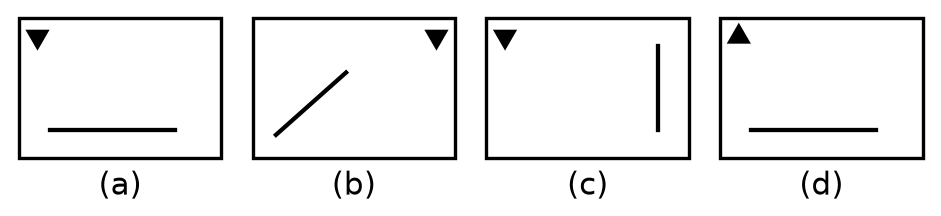
The elements of the problem figures given below are changing with a certain rule as we observe them from left to right:
According to this rule, which of the following would be the next figure if the changes were continued with the same rule?
Answer (d) & explanation
Figure (d) is correct. Step 1: watch the black triangle. It moves round the corners anticlockwise: top-left, bottom-left, bottom-right, top-right. Next it returns to the top-left. Step 2: the triangle points up, down, up, down in turn, so next it points up. Step 3: the line turns a little each time: upright, slightly tilted, slanting, nearly flat. Next it becomes flat (horizontal). A flat line with an upward triangle in the top-left corner is (d). So (a), (b) and (c) fail.
Tip: in figure series, follow one element at a time (position, direction, angle). Write a short rule for each, then combine the rules to build the next figure.
(a) has the right line and corner but the triangle points down.
Answer as per the official UPSC answer key.
You are the chairperson of a state sports committee. You have received a complaint and later it was found that an athlete in the junior age category who has won a medal has crossed the age criteria by 5 days. You would...
Answer (a) & explanation
(a) and (d) are both correct (UPSC accepted both; no negative marking). Step 1: an athlete was found 5 days over the age limit after winning a medal. You must act fairly and follow due process. Step 2: (a) asking the screening committee to explain how the error happened, and (d) taking the views of the sports committee, both gather facts before a decision. Step 3: (b) taking the medal back at once skips due process. (c) a court affidavit cannot change the athlete's real age.
Tip: for these interpersonal items, pick the response that is lawful, honest and fixes the real problem through proper channels. Avoid options that give in, run away from duty or act without hearing the facts.
Answer as per the official UPSC answer key.
Mr. Kumar drives to work at an average speed of 48 km/h. The time taken to cover the first 60% of the distance is 10 minutes more than the time taken to cover the remaining distance. How far is his office?
Answer (b) & explanation
40 km is correct (b). Step 1: the speed is the same all the way, so time depends only on distance. The first part is 60% of the distance and the rest is 40%. The 10-minute gap comes from the extra 20% of the distance. Step 2: in 10 minutes at 48 km/h he covers 48 × 10/60 = 8 km. So 20% of the distance = 8 km. Step 3: the full distance = 8 × 5 = 40 km. Check: 24 km takes 30 min, 16 km takes 20 min, a 10-minute gap. So (a), (c) and (d) fail.
Tip: at a constant speed, a time difference equals a distance difference. Turn minutes into km first and the rest is simple percentage.
Answer as per the official UPSC answer key.