
CSAT (Paper II): previous-year questions
1280 real UPSC Prelims questions (2011–2026) with the official answer and a clear explanation. 400 of them came in the last five papers.
How often UPSC asks this
Questions per year, counted from the official papers.
Subtopics
Arrangements, ranking, ordering and puzzles
142 questions
Clocks and calendars
5 questions
Coding-decoding, series, patterns, cubes, dice and visual reasoning
110 questions
Communication, interpersonal skills and decision-making
10 questions
Counting, permutations, combinations and probability
1 questions
Directions, blood relations and Venn diagrams
60 questions
General English: grammar, vocabulary and comprehension
20 questions
General Hindi: grammar, vocabulary, dialects and comprehension
25 questions
Geometry and mensuration
26 questions
Number system and basic algebra (divisibility, HCF/LCM, remainders, digits, equations)
196 questions
Percentages, profit and loss, discount, simple and compound interest
47 questions
Ratio, proportion, averages, mixtures and alligation
47 questions
Syllogisms, statements and conclusions, assumptions and arguments
89 questions
Time and work; pipes and cisterns
2 questions
Time, speed and distance; trains, boats and streams; races
48 questions
Attempt the questions
Newest papers first. Tap an option; the answer and the reason appear instantly.
Read the passage
In a typical Western liberal context, deepening of democracy invariably leads to consolidation of ‘liberal values’. In the Indian context, democratization is translated into greater involvement of people not as ‘individuals’ which is a staple to liberal discourse, but as communities or groups. Individuals are getting involved in the public sphere not as ‘atomized’ individuals but as members of primordial communities drawn on religious or caste identity. Community-identity seems to be the governing force. It is not therefore surprising that the so-called peripheral groups continue to maintain their identities with reference to the social groups (caste, religion or sect) to which they belong while getting involved in the political processes despite the fact that their political goals remain more or less identical. By helping to articulate the political voice of the marginalized, democracy in India has led to ‘a loosening of social strictures’ and empowered the peripherals to be confident of their ability to improve the socio-economic conditions in which they are placed. This is a significant political process that had led to a silent revolution through a meaningful transfer of power from the upper caste elites to various subaltern groups within the democratic framework of public governance.
What is the “silent revolution” that has occurred in the Indian democratic process ?
Answer (c) & explanation
(c) is correct. Step 1: the passage says democracy led to 'a silent revolution through a meaningful transfer of power from the upper caste elites to various subaltern groups'. That is exactly (c). Step 2: (a) is wrong: caste is still very relevant; community identity is called 'the governing force'. Step 3: (b) is wrong: 'loosening of social strictures' is mentioned, but not in voting behaviour and patterns; it refers to the marginalized gaining confidence. Since (a) and (b) fail, (d) fails too.
Tip: when the passage defines a quoted phrase in the same sentence ('a silent revolution through…'), the answer is usually that definition. Read the words right after the phrase.
Answer as per the official UPSC answer key.
Read the passage
Education, without a doubt, has an important functional, instrumental and utilitarian dimension. This is revealed when one asks questions such as ‘what is the purpose of education ?’. The answers, too often, are ‘to acquire qualifications for employment/upward mobility’, ‘wider/higher (in terms of income) opportunities’, and ‘to meet the needs for trained human power in diverse fields for national development’. But in its deepest sense education is not instrumentalist. That is to say, it is not to be justified outside of itself because it leads to the acquisition of formal skills or of certain desired psychological – social attributes. It must be respected in itself. Education is thus not a commodity to be acquired or possessed and then used, but a process of inestimable importance to individuals and society, although it can and does have enormous use-value. Education then, is a process of expansion and conversion, not in the sense of converting or turning students into doctors or engineers, but the widening and turning out of the mind — the creation, sustenance and development of self-critical awareness and independence of thought. It is an inner process of moral – intellectual development.
Education is a process in which
Answer (c) & explanation
'Self-critical awareness and independence of thought' is correct (c). Step 1: the passage calls education 'a process of expansion and conversion' and explains it as 'the creation, sustenance and development of self-critical awareness and independence of thought'. Step 2: (a) is a trap: the author says conversion is 'not in the sense of converting or turning students into doctors or engineers'. Step 3: (b) higher income and (d) qualifications for mobility belong to the instrumentalist view the author treats as shallow. So (a), (b) and (d) fail.
Tip: watch for a word the passage uses in a special sense. Here 'conversion' means turning the mind outward, not producing professionals; the author even warns against the ordinary meaning.
Answer as per the official UPSC answer key.
Read the passage
Most champions of democracy have been rather reticent in suggesting that democracy would itself promote development and enhancement of social welfare — they have tended to see them as good but distinctly separate and largely independent goals. The detractors of democracy, on the other hand, seemed to have been quite willing to express their diagnosis of what they see as serious tensions between democracy and development. The theorists of the practical split — “Make up your mind : do you want democracy, or instead, do you want development ?” — often came, at least to start with, from East Asian countries, and their voice grew in influence as several of these countries were immensely successful — through the 1970s and 1980s and even later — in promoting economic growth without pursuing democracy.
To deal with these issues we have to pay particular attention to both the content of what can be called development and to the interpretation of democracy (in particular to the respective roles of voting and of public reasoning). The assessment of development cannot be divorced from the lives that people can lead and the real freedom that they enjoy. Development can scarcely be seen merely in terms of enhancement of inanimate objects of convenience, such as a rise in the GNP (or in personal incomes), or industrialization — important as they may be as means to the real ends. Their value must depend on what they do to the lives and freedom of the people involved, which must be central to the idea of development.
If development is understood in a broader way, with a focus on human lives, then it becomes immediately clear that the relation between development and democracy has to be seen partly in terms of their constitutive connection, rather than only through their external links. Even though the question has often been asked whether political freedom is “conducive to development”, we must not miss the crucial recognition that political liberties and democratic rights are among the “constituent components” of development. Their relevance for development does not have to be established indirectly through their contribution to the growth of GNP.
What does a “constitutive” connection between democracy and development imply ?
Answer (c) & explanation
(c) is correct. Step 1: the passage says political liberties and democratic rights are 'among the constituent components of development'. 'Constitutive' means they are part of what development is, not just a cause of it. Step 2: (a) is wrong: the author says the link should be seen 'partly in terms of their constitutive connection, rather than only through their external links'. Step 3: (b) is wrong because of 'only': the passage does not say rights alone lead to economic growth; it says their value need not be shown through GNP at all. Since (c) is right, (d) fails.
Tip: 'constitutive' = 'part of the make-up'. Think of bricks in a wall, not a tool used to build it.
Answer as per the official UPSC answer key.
Read the passage
For fourteen and a half months I lived in my little cell or room in the Dehradun jail, and I began to feel as if I was almost a part of it. I was familiar with every bit of it, I knew every mark and dent on the whitewashed walls and on the uneven floor and the ceiling with its moth-eaten rafters. In the little yard outside I greeted little tufts of grass and odd bits of stone as old friends. I was not alone in my cell, for several colonies of wasp and hornets lived there, and many lizards found a home behind the rafters, emerging in the evenings in search of prey.
The passage attempts to describe
Answer (c) & explanation
(c) is correct. Step 1: the prisoner knows every dent in the walls, greets 'little tufts of grass and odd bits of stone as old friends', and notices the wasps, hornets and lizards that share his cell. These details show a man making a conscious effort to cope with loneliness. Step 2: (a) is wrong: he describes one cell, not the country's jails in general. Step 3: (b) is true on the surface, but noticing details is the means, not the purpose. (d) overstates: he does not say he lived happily with the creatures. So (a), (b) and (d) fail.
Tip: ask why the author gives these details. The purpose behind them is usually the main idea.
Answer as per the official UPSC answer key.
Read the passage
Today’s developing economies use much less energy per capita than developed countries such as the United States did at similar incomes, showing the potential for lower-carbon growth. Adaptation and mitigation need to be integrated into a climate-smart development strategy that increases resilience, reduces the threat of further global warming, and improves development outcomes. Adaptation and mitigation measures can advance development, and prosperity can raise incomes and foster better institutions. A healthier population living in better-built houses and with access to bank loans and social security is better equipped to deal with a changing climate and its consequences. Advancing robust, resilient development policies that promote adaptation is needed today because changes in the climate, already begun, will increase even in the short term.
The spread of economic prosperity has always been intertwined with adaptation to changing ecological conditions. But as growth has altered the environment and as environmental change has accelerated, sustaining growth and adaptability demands greater capacity to understand our environment, generate new adaptive technologies and practices, and diffuse them widely. As economic historians have explained, much of humankind’s creative potential has been directed at adapting to the changing world. But adaptation cannot cope with all the impacts related to climate change, especially as larger changes unfold in the long term.
Countries cannot grow out of harm’s way fast enough to match the changing climate. And some growth strategies, whether driven by the government or the market, can also add to vulnerability — particularly if they overexploit natural resources. Under the Soviet development plan, irrigated cotton cultivation expanded in water-stressed Central Asia and led to the near disappearance of the Aral Sea, threatening the livelihoods of fishermen, herders and farmers. And clearing mangroves — the natural coastal buffers against storm surges — to make way for intensive farming or housing development, increases the physical vulnerability of coastal settlements, whether in Guinea or in Louisiana.
Consider the following assumptions :
- 1. Sustainable economic growth demands the use of creative potential of man.
- 2. Intensive agriculture can lead to ecological backlash.
- 3. Spread of the economic prosperity can adversely affect the ecology and environment.
With reference to the passage, which of the above assumptions is/are valid ?
Answer (d) & explanation
All three assumptions are valid (d). Step 1: the passage says 'much of humankind's creative potential has been directed at adapting', and sustaining growth needs new adaptive technologies. So growth depends on human creativity: 1 is valid. Step 2: irrigated cotton led to the 'near disappearance of the Aral Sea', and mangroves were cleared for intensive farming. Intensive agriculture can backfire on ecology: 2 is valid. Step 3: it also says 'growth has altered the environment' and some growth strategies 'add to vulnerability'. So spreading prosperity can harm ecology: 3 is valid. Hence (a), (b) and (c) fail.
Tip: an assumption is valid if the passage takes it for granted or shows it through an example.
Answer as per the official UPSC answer key.
Consider the following information regarding the performance of a class of 1000 students in four different tests:
| Tests | I | II | III | IV |
|---|---|---|---|---|
| Average marks | 60 | 60 | 70 | 80 |
| Range of marks | 30 to 90 | 45 to 75 | 20 to 100 | 0 to 100 |
If a student scores 74 marks in each of the four tests, in which one of the following tests is her performance the best comparatively?
Answer (b) & explanation
1. 74 is good or bad only compared with how others scored. Ask: how close is 74 to the top mark of that test?
2. Test I: top is 90, so 74 is 16 marks short. Test III: 26 short of 100. Test IV: 26 short of 100, and below the average of 80.
3. Test II: top is only 75, so 74 is just 1 mark below the best student, and 14 above the average.
4. Her best showing is in Test II.
Answer as per the official UPSC answer key.
You are handling a priority project and have been meeting all the deadlines and are therefore planning your leave during the project. Your immediate boss does not grant your leave citing the urgency of the project. You would...
Answer (c) & explanation
(c) and (d) are both correct (UPSC accepted both; no negative marking). Step 1: your leave was refused because the project is urgent, though you have met all deadlines. Step 2: (d) telling the boss honestly that the refusal is not justified, and (c) asking a higher authority to reconsider, are both honest and within the rules. Step 3: (a) going on leave without sanction breaks service rules. (b) pretending to be sick is dishonest and can lead to disciplinary action.
Tip: for these interpersonal items, pick the response that is lawful, honest and fixes the real problem through proper channels. Avoid options that give in, run away from duty or act without hearing the facts.
Answer as per the official UPSC answer key.
Gita is prettier than Sita but not as pretty as Rita. Then,
Answer (a) & explanation
'Sita is not as pretty as Gita' is correct (a). Step 1: 'Gita is prettier than Sita' gives Gita > Sita. Step 2: 'but not as pretty as Rita' gives Rita > Gita. So the order is Rita > Gita > Sita. Step 3: (a) says Sita is not as pretty as Gita, which is true. (b) says Sita is prettier than Rita, but Sita is last. (c) says Rita is not as pretty as Gita, but Rita is first. (d) says Gita is prettier than Rita, the opposite of the second clue. So (b), (c) and (d) fail.
Tip: turn each comparison into a '>' sign and line everyone up from top to bottom. Then check each option against the line.
Answer as per the official UPSC answer key.
Directions for the following 5 (five) items: Examine the information given in the following paragraph and answer the items that follow:
Guest lectures on five subjects viz., Economics, History, Statistics, English and Mathematics have to be arranged in a week from Monday to Friday. Only one lecture can be arranged on each day. Economics cannot be scheduled on Tuesday. Guest faculty for History is available only on Tuesday. Mathematics lecture has to be scheduled immediately after the day of Economics lecture. English lecture has to be scheduled immediately before the day of Economics lecture.
Which lecture is scheduled on Monday?
Answer (d) & explanation
Statistics is correct (d). Step 1: History is fixed on Tuesday. Step 2: English must come immediately before Economics, and Mathematics immediately after it. So English, Economics, Mathematics take three days in a row. With Tuesday taken, the only three free days in a row are Wednesday, Thursday, Friday. Economics on Thursday also obeys 'not on Tuesday'. Step 3: so Wednesday English, Thursday Economics, Friday Mathematics, and the only day left, Monday, gets Statistics. Full week: Mon Statistics, Tue History, Wed English, Thu Economics, Fri Mathematics. So (a), (b) and (c) fail.
Tip: place the fixed item first, then fit the block of linked items into the gaps that remain.
Answer as per the official UPSC answer key.
Read the passage
Chemical pesticides lose their role in sustainable agriculture if the pests evolve resistance. The evolution of pesticide resistance is simply natural selection in action. It is almost certain to occur when vast numbers of a genetically variable population are killed. One or a few individuals may be unusually resistant (perhaps because they possess an enzyme that can detoxify the pesticide). If the pesticide is applied repeatedly, each successive generation of the pest will contain a larger proportion of resistant individuals. Pests typically have a high intrinsic rate of reproduction, and so a few individuals in one generation may give rise to hundreds or thousands in the next, and resistance spreads very rapidly in a population.
This problem was often ignored in the past, even though the first case of DDT (dichlorodiphenyltrichloroethane) resistance was reported as early as 1946. There is exponential increase in the numbers of invertebrates that have evolved resistance and in the number of pesticides against which resistance has evolved. Resistance has been recorded in every family of arthropod pests (including dipterans such as mosquitoes and house flies, as well as beetles, moths, wasps, fleas, lice and mites) as well as in weeds and plant pathogens. Take the Alabama leafworm, a moth pest of cotton, as an example. It has developed resistance in one or more regions of the world to aldrin, DDT, dieldrin, endrin, lindane and toxaphene.
If chemical pesticides brought nothing but problems, — if their use was intrinsically and acutely unsustainable — then they would already have fallen out of widespread use. This has not happened. Instead, their rate of production has increased rapidly. The ratio of cost to benefit for the individual agricultural producer has remained in favour of pesticide use. In the USA, insecticides have been estimated to benefit the agricultural products to the tune of around $5 for every $1 spent.
Moreover, in many poorer countries, the prospect of imminent mass starvation, or of an epidemic disease, are so frightening that the social and health costs of using pesticides have to be ignored. In general the use of pesticides is justified by objective measures such as ‘lives saved’, ‘economic efficiency of food production’ and ‘total food produced’. In these very fundamental senses, their use may be described as sustainable. In practice, sustainability depends on continually developing new pesticides that keep at least one step ahead of the pests — pesticides that are less persistent, biodegradable and more accurately targeted at the pests.
“The evolution of pesticide resistance is natural selection in action.” What does it actually imply ?
Answer (c) & explanation
'Some individuals show resistance' is correct (c). Step 1: the passage explains natural selection here: 'One or a few individuals may be unusually resistant'. When the pesticide kills the rest, these few survive and breed, so each generation has more resistant pests. Step 2: (a) says it is natural for many organisms to be resistant; the passage says only a few are at the start. Step 3: (b) 'universal' overstates even more. Since (c) is right, (d) fails.
Tip: natural selection always starts with a small variation in a few individuals that helps them survive. Options with 'many', 'all' or 'universal' usually overstate such passages.
Answer as per the official UPSC answer key.
Read the passage
The need for Competition Law becomes more evident when foreign direct investment (FDI) is liberalised. The impact of FDI is not always pro-competitive. Very often FDI takes the form of a foreign corporation acquiring a domestic enterprise or establishing a joint venture with one. By making such an acquisition the foreign investor may substantially lessen competition and gain a dominant position in the relevant market, thus charging higher prices. Another scenario is where the affiliates of two separate multinational companies (MNCs) have been established in competition with one another in a particular developing economy, following the liberalisation of FDI. Subsequently, the parent companies overseas merge. With the affiliates no longer remaining independent, competition in the host country may be virtually eliminated and the prices of the products may be artificially inflated. Most of these adverse consequences of mergers and acquisitions by MNCs can be avoided if an effective competition law is in place. Also, an economy that has implemented an effective competition law is in a better position to attract FDI than one that has not. This is not just because most MNCs are expected to be accustomed to the operation of such a law in their home countries and know how to deal with such concerns but also that MNCs expect competition authorities to ensure a level playing field between domestic and foreign firms.
With reference to the passage, consider the following statements :
- 1. It is desirable that the impact of Foreign Direct Investment should be pro-competitive.
- 2. The entry of foreign investors invariably leads to the inflated prices in domestic markets.
Which of the statements given above is/are correct ?
Answer (a) & explanation
Only statement 1 is correct (a). Step 1: the passage begins by saying the impact of FDI 'is not always pro-competitive' and shows how it can harm competition. This implies it is desirable for FDI to be pro-competitive: 1 is right. Step 2: statement 2 says foreign entry invariably inflates prices. The passage says a dominant investor 'may' charge higher prices and prices 'may be artificially inflated' in certain cases like mergers. 'May' is not 'always', so 2 is wrong. Step 3: hence (b), (c) and (d) fail.
Tip: 'invariably', 'always' and 'never' need equally strong words in the passage. If the passage says 'may' or 'can', the strong option fails.
Answer as per the official UPSC answer key.
Read the passage
For fourteen and a half months I lived in my little cell or room in the Dehradun jail, and I began to feel as if I was almost a part of it. I was familiar with every bit of it, I knew every mark and dent on the whitewashed walls and on the uneven floor and the ceiling with its moth-eaten rafters. In the little yard outside I greeted little tufts of grass and odd bits of stone as old friends. I was not alone in my cell, for several colonies of wasp and hornets lived there, and many lizards found a home behind the rafters, emerging in the evenings in search of prey.
The author of the passage seems to suggest that
Answer (a) & explanation
(a) is correct. Step 1: over fourteen and a half months, the prisoner came to feel 'almost a part of' a bare cell with dents, moth-eaten rafters and insects. This shows a person can adjust to unpleasant surroundings. Step 2: (b) and (d) are wrong: he does not judge whether Indian prisons are good or need improvement. Step 3: (c) is wrong: he never says prison life is easy; the effort to find company in grass and stones shows it was hard. So (b), (c) and (d) fail.
Tip: 'the author seems to suggest' asks for the general lesson from the story. Choose the broad idea and reject options about topics (prison policy) the author never discusses.
Answer as per the official UPSC answer key.
Read the passage
Today’s developing economies use much less energy per capita than developed countries such as the United States did at similar incomes, showing the potential for lower-carbon growth. Adaptation and mitigation need to be integrated into a climate-smart development strategy that increases resilience, reduces the threat of further global warming, and improves development outcomes. Adaptation and mitigation measures can advance development, and prosperity can raise incomes and foster better institutions. A healthier population living in better-built houses and with access to bank loans and social security is better equipped to deal with a changing climate and its consequences. Advancing robust, resilient development policies that promote adaptation is needed today because changes in the climate, already begun, will increase even in the short term.
The spread of economic prosperity has always been intertwined with adaptation to changing ecological conditions. But as growth has altered the environment and as environmental change has accelerated, sustaining growth and adaptability demands greater capacity to understand our environment, generate new adaptive technologies and practices, and diffuse them widely. As economic historians have explained, much of humankind’s creative potential has been directed at adapting to the changing world. But adaptation cannot cope with all the impacts related to climate change, especially as larger changes unfold in the long term.
Countries cannot grow out of harm’s way fast enough to match the changing climate. And some growth strategies, whether driven by the government or the market, can also add to vulnerability — particularly if they overexploit natural resources. Under the Soviet development plan, irrigated cotton cultivation expanded in water-stressed Central Asia and led to the near disappearance of the Aral Sea, threatening the livelihoods of fishermen, herders and farmers. And clearing mangroves — the natural coastal buffers against storm surges — to make way for intensive farming or housing development, increases the physical vulnerability of coastal settlements, whether in Guinea or in Louisiana.
Which one of the following statements constitutes central theme of this passage ?
Answer (b) & explanation
'Integrate adaptation and mitigation with development' is correct (b). Step 1: the passage's key sentence is: 'Adaptation and mitigation need to be integrated into a climate-smart development strategy.' Everything else supports this point. Step 2: (a) is true (healthier, better-housed people cope better), but it is a supporting detail, not the main theme. (d) is also only an example (Aral Sea, mangroves). Step 3: (c) is wrong: the passage never says growth should not be pursued; it wants better, climate-smart growth. So (a), (c) and (d) fail.
Tip: the central theme is usually a broad 'need to' or 'should' sentence. Examples and supporting facts are true but too narrow to be the theme.
Answer as per the official UPSC answer key.
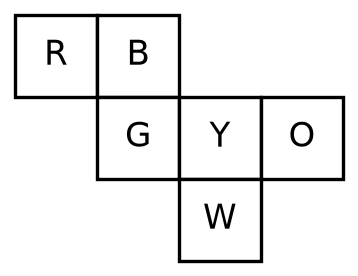
Six squares are coloured, front and back, red (R), blue (B), yellow (Y), green (G), white (W) and orange (O) and are hinged together as shown in the figure given below. If they were folded to form a cube, what would be the face opposite the white face?
Answer (c) & explanation
B is correct (c). Step 1: keep Y as the front face. In the net, G folds to the left, O to the right and W folds under to become the bottom. Step 2: B is attached to the top of G. When G folds to the left side, B lands on the top of the cube. Step 3: top and bottom are opposite, so B is opposite W. R then folds round to the back, opposite Y. So R, G and O are not opposite white, and (a), (b) and (d) fail.
Tip: in a cube net, fix one face as the front and fold the others one by one. Two faces that are separated by one square in a straight line of the net are usually opposite.
Answer as per the official UPSC answer key.
You are involved in setting up a water supply project in a remote area. Full recovery of cost is impossible in any case. The income levels in the area are low and 25% of the population is below poverty line (BPL). When a decision has to be taken on pricing you would...
Answer (c) & explanation
(c) and (d) are both correct (UPSC accepted both; no negative marking). Step 1: full cost recovery is impossible, incomes are low and 25% of people are BPL. A fair price must protect the poor but still recover some cost. Step 2: (c) free water for BPL and a fixed charge for others, and (d) charges by use with lower rates for BPL, both do this; (d) also discourages waste. Step 3: (a) free water for all recovers nothing and invites waste. (b) a one-time fee with free use does the same.
Tip: for these interpersonal items, pick the response that is lawful, honest and fixes the real problem through proper channels. Avoid options that give in, run away from duty or act without hearing the facts.
Answer as per the official UPSC answer key.
Given that,
- 1. A is the brother of B.
- 2. C is the father of A.
- 3. D is the brother of E.
- 4. E is the daughter of B.
Then the uncle of D is
Answer (a) & explanation
A is correct (a). Step 1: E is the daughter of B, and D is the brother of E. So D is also a child of B. Step 2: A is the brother of B. So A is the brother of D's parent. Step 3: a parent's brother is an uncle, so A is D's uncle. B is D's parent, C is D's grandfather (C is the father of A, and so also of B, since A and B are brothers), and E is D's sister. So (b), (c) and (d) fail.
Tip: draw a small family tree. Put B in the middle, A beside B as a sibling, C above them and D and E below B. The uncle is then easy to see.
Answer as per the official UPSC answer key.
(Same information as the question above.)
Which lecture is scheduled between Statistics and English?
Answer (b) & explanation
History is correct (b). Step 1: from the schedule worked out from the clues: Mon Statistics, Tue History, Wed English, Thu Economics, Fri Mathematics. (History is fixed on Tuesday; English–Economics–Mathematics must run on three days in a row, which can only be Wed–Fri; Statistics takes Monday.) Step 2: Statistics is on Monday and English on Wednesday. Step 3: the lecture between them, on Tuesday, is History. Economics and Mathematics come after English, and there is a lecture between them, so (a), (c) and (d) fail.
Tip: in a set of linked questions, build the full timetable once and write it down. Each later question then takes a few seconds and you avoid repeating errors.
Answer as per the official UPSC answer key.
Read the passage
Chemical pesticides lose their role in sustainable agriculture if the pests evolve resistance. The evolution of pesticide resistance is simply natural selection in action. It is almost certain to occur when vast numbers of a genetically variable population are killed. One or a few individuals may be unusually resistant (perhaps because they possess an enzyme that can detoxify the pesticide). If the pesticide is applied repeatedly, each successive generation of the pest will contain a larger proportion of resistant individuals. Pests typically have a high intrinsic rate of reproduction, and so a few individuals in one generation may give rise to hundreds or thousands in the next, and resistance spreads very rapidly in a population.
This problem was often ignored in the past, even though the first case of DDT (dichlorodiphenyltrichloroethane) resistance was reported as early as 1946. There is exponential increase in the numbers of invertebrates that have evolved resistance and in the number of pesticides against which resistance has evolved. Resistance has been recorded in every family of arthropod pests (including dipterans such as mosquitoes and house flies, as well as beetles, moths, wasps, fleas, lice and mites) as well as in weeds and plant pathogens. Take the Alabama leafworm, a moth pest of cotton, as an example. It has developed resistance in one or more regions of the world to aldrin, DDT, dieldrin, endrin, lindane and toxaphene.
If chemical pesticides brought nothing but problems, — if their use was intrinsically and acutely unsustainable — then they would already have fallen out of widespread use. This has not happened. Instead, their rate of production has increased rapidly. The ratio of cost to benefit for the individual agricultural producer has remained in favour of pesticide use. In the USA, insecticides have been estimated to benefit the agricultural products to the tune of around $5 for every $1 spent.
Moreover, in many poorer countries, the prospect of imminent mass starvation, or of an epidemic disease, are so frightening that the social and health costs of using pesticides have to be ignored. In general the use of pesticides is justified by objective measures such as ‘lives saved’, ‘economic efficiency of food production’ and ‘total food produced’. In these very fundamental senses, their use may be described as sustainable. In practice, sustainability depends on continually developing new pesticides that keep at least one step ahead of the pests — pesticides that are less persistent, biodegradable and more accurately targeted at the pests.
With reference to the passage, consider the following statements :
- 1. Use of chemical pesticides has become imperative in all the poor countries of the world.
- 2. Chemical pesticides should not have any role in sustainable agriculture.
- 3. One pest can develop resistance to many pesticides.
Which of the statements given above is/are correct ?
Answer (b) & explanation
Only statement 3 is correct (b). Step 1: the Alabama leafworm has become resistant to six pesticides (aldrin, DDT, dieldrin, endrin, lindane, toxaphene). So one pest can resist many pesticides: 3 is right. Step 2: statement 1 says pesticides are imperative in all poor countries. The passage only says 'many poorer countries' face fears of starvation or epidemics. So 1 overstates. Step 3: statement 2 says pesticides should have no role in sustainable agriculture. The passage calls their use sustainable 'in these very fundamental senses'. So 2 is wrong, and (a), (c) and (d) fail.
Tip: compare quantity words carefully: 'many' in the passage never supports 'all' in an option.
Answer as per the official UPSC answer key.
Read the passage
The need for Competition Law becomes more evident when foreign direct investment (FDI) is liberalised. The impact of FDI is not always pro-competitive. Very often FDI takes the form of a foreign corporation acquiring a domestic enterprise or establishing a joint venture with one. By making such an acquisition the foreign investor may substantially lessen competition and gain a dominant position in the relevant market, thus charging higher prices. Another scenario is where the affiliates of two separate multinational companies (MNCs) have been established in competition with one another in a particular developing economy, following the liberalisation of FDI. Subsequently, the parent companies overseas merge. With the affiliates no longer remaining independent, competition in the host country may be virtually eliminated and the prices of the products may be artificially inflated. Most of these adverse consequences of mergers and acquisitions by MNCs can be avoided if an effective competition law is in place. Also, an economy that has implemented an effective competition law is in a better position to attract FDI than one that has not. This is not just because most MNCs are expected to be accustomed to the operation of such a law in their home countries and know how to deal with such concerns but also that MNCs expect competition authorities to ensure a level playing field between domestic and foreign firms.
According to the passage, how does a foreign investor dominate the relevant domestic market ?
- 1. Multinational companies get accustomed to domestic laws.
- 2. Foreign companies establish joint ventures with domestic companies.
- 3. Affiliates in a particular market/sector lose their independence as their parent companies overseas merge.
- 4. Foreign companies lower the cost of their products as compared to that of products of domestic companies.
Which of the statements given above are correct ?
Answer (b) & explanation
2 and 3 are correct (b). Step 1: the passage says a foreign investor may gain a dominant position by acquiring a domestic firm or setting up a joint venture with one (2). Step 2: it also says when parent MNCs overseas merge, their local affiliates stop competing and competition 'may be virtually eliminated' (3). Step 3: statement 1 is wrong: MNCs are used to competition law in their home countries, and that is a reason they invest, not how they dominate. Statement 4 is wrong: dominance leads to higher prices, not lower costs. So (a), (c) and (d) fail.
Tip: answer the exact question ('how does it dominate') and ignore true facts that answer a different one.
Answer as per the official UPSC answer key.
Read the passage
We started pitching the highest camp that has ever been made. Everything took five times as long as it would have taken in a place where there was enough air to breathe; but at last we got the tent up, and when we crawled in, it was not too bad. There was only a light wind, and inside it was not too cold for us to take off our gloves. At night most climbers take off their boots; but I prefer to keep them on. Hillary, on the other hand, took his off and laid them next to his sleeping bag.
What does the expression “pitching the highest camp” imply ?
Answer (c) & explanation
(c) is correct. Step 1: the author says they were pitching 'the highest camp that has ever been made'. So nobody had ever camped that high before. Step 2: (a) is wrong: they were still pitching a camp, so they had not yet reached the summit. Step 3: (b) is wrong: the passage does not say earlier climbers reached that height without camping; it implies no one had camped there. (d) is wrong: 'highest' refers to height, not to a big camp for many climbers. So (a), (b) and (d) fail.
Tip: read the key word carefully: 'highest' is about altitude. Do not mix up 'high' with 'large'. 'Ever' makes it a record.
Answer as per the official UPSC answer key.