
CSAT (Paper II): previous-year questions
1280 real UPSC Prelims questions (2011–2026) with the official answer and a clear explanation. 400 of them came in the last five papers.
How often UPSC asks this
Questions per year, counted from the official papers.
Subtopics
Arrangements, ranking, ordering and puzzles
142 questions
Clocks and calendars
5 questions
Coding-decoding, series, patterns, cubes, dice and visual reasoning
110 questions
Communication, interpersonal skills and decision-making
10 questions
Counting, permutations, combinations and probability
1 questions
Directions, blood relations and Venn diagrams
60 questions
General English: grammar, vocabulary and comprehension
20 questions
General Hindi: grammar, vocabulary, dialects and comprehension
25 questions
Geometry and mensuration
26 questions
Number system and basic algebra (divisibility, HCF/LCM, remainders, digits, equations)
196 questions
Percentages, profit and loss, discount, simple and compound interest
47 questions
Ratio, proportion, averages, mixtures and alligation
47 questions
Syllogisms, statements and conclusions, assumptions and arguments
89 questions
Time and work; pipes and cisterns
2 questions
Time, speed and distance; trains, boats and streams; races
48 questions
Attempt the questions
Newest papers first. Tap an option; the answer and the reason appear instantly.
(Same passage and graph as the question above.)
Which region of the curve indicates that the person began showing the symptoms of infection?
Answer (b) & explanation
B is correct (b). Step 1: symptoms such as fever and loose motions start when the bacteria begin to multiply quickly and the body reacts. Step 2: on the graph, the curve starts climbing fast in region B, right after the flat incubation stretch A. That is where he began to show symptoms. Step 3: A is the quiet incubation phase; C and D are the later stages when he was already ill, before and around the peak. So (a), (c) and (d) fail.
Tip: the start of a steep rise marks the start of trouble. Find where the curve first turns sharply upward.
Answer as per the official UPSC answer key.
Read the passage
He walked several miles that day but could not get anything to eat or drink except some dry bread and some water, which he got from cottagers and farmers. As night fell, he slept under a haystack lying in a meadow. He felt frightened at first, for the wind blew awfully over the empty fields. He felt cold and hungry, and was feeling more lonely than he had ever felt before. He, however, soon fell asleep, being much tired with his long walk. When he got up next day, he was feeling terribly hungry so he purchased a loaf of bread with a few coins that he had.
When the night fell, he slept
Answer (b) & explanation
Under a pile of dry grass is correct (b). Step 1: the passage says 'he slept under a haystack lying in a meadow'. Step 2: a haystack is a large pile of dried grass (hay) stored for animals. So 'under a pile of dry grass' means the same thing: (b). Step 3: (a) is wrong: the meadow is only where the haystack stood, and he was under the haystack, not in the open. (c) is wrong: he got food from cottagers but did not sleep in a cottage. (d) is wrong: no tree is mentioned.
Tip: these questions test vocabulary. Replace the passage's word with its plain meaning, then match the option.
Answer as per the official UPSC answer key.
The following item consists of four statements. Of these four statements, two cannot both be true, but both can be false. Study the statements carefully and identify the two that satisfy the above condition.
- 1. All trains are run by diesel engine.
- 2. Some trains are run by diesel engine.
- 3. No train is run by diesel engine.
- 4. Some trains are not run by diesel engine.
Answer (c) & explanation
Statements 1 and 3 are correct (c). Step 1: we need two statements that cannot both be true but can both be false. Step 2: 'All trains are run by diesel' (1) and 'No train is run by diesel' (3) clash, so they cannot both be true. If only some trains use diesel and others are electric, both are false. So 1 and 3 fit. Step 3: check others. 1 and 4 are exact opposites: one must be true. 2 and 3 are also exact opposites. 1 and 2 can both be true. So (a), (b) and (d) fail.
Tip: this is the same pattern as the question before. Learn it once: All vs None is always the answer to 'cannot both be true, can both be false'.
Answer as per the official UPSC answer key.
A village having a population of 4000 requires 150 litres of water per head per day. It has a tank measuring 20 m × 15 m × 6 m. The water of this tank will last for
Answer (b) & explanation
3 days is correct (b). Step 1: the tank's volume = 20 × 15 × 6 = 1,800 m³. Since 1 m³ = 1,000 litres, it holds 18,00,000 litres. Step 2: the village needs 4,000 people × 150 litres = 6,00,000 litres every day. Step 3: the water lasts 18,00,000 ÷ 6,00,000 = 3 days. So (a), (c) and (d) fail.
Tip: always convert units before dividing. Remember that 1 cubic metre is 1,000 litres; forgetting this gives answers that are a thousand times too big or too small. Write the units next to each number as you go.
Answer as per the official UPSC answer key.
You have to accomplish a very important task for your Headquarters within the next two days. Suddenly you meet with an accident. Your office insists that you complete the task. You would
Answer (a) & explanation
UPSC's key lists (a) and (c), with no negative marking. Step 1: you are injured, but the task for Headquarters is important. Step 2: (a) asking for an extension keeps you responsible for the task with a realistic timeline, and (c) suggesting an alternate person ensures the work gets done on time. Both keep the task alive. Step 3: (b) only reports inability without a solution. (d) staying away abandons the task and leaves Headquarters stranded.
Tip: for these interpersonal items, pick the response that is lawful, honest and keeps the public work going. Avoid options that give in to pressure, pass the buck or abandon duty.
Answer as per the official UPSC answer key.
Read the passage
A moral act must be our own act; must spring from our own will. If we act mechanically, there is no moral content in our act. Such action would be moral, if we think it proper to act like a machine and do so. For, in doing so, we use our discrimination. We should bear in mind the distinction between acting mechanically and acting intentionally. It may be moral of a king to pardon a culprit. But the messenger carrying out the order of pardon plays only a mechanical part in the king’s moral act. But if the messenger were to carry out the king’s order considering it to be his duty, his action would be a moral one. How can a man understand morality who does not use his own intelligence and power of thought, but lets himself be swept along like a log of wood by a current ? Sometimes a man defies convention and acts on his own with a view to absolute good.
The passage contains a statement “lets himself be swept along like a log of wood by a current”. Among the following statements, which is/are nearest in meaning to this ?
- 1. A person does not use his own reason.
- 2. He is susceptible to influence/pressure.
- 3. He cannot withstand difficulties/challenges.
- 4. He is like a log of wood.
Select the correct answer using the codes given below :
Answer (b) & explanation
Statements 1 and 2 are correct (b). Step 1: the passage asks how a man can understand morality 'who does not use his own intelligence and power of thought'. That matches statement 1. Step 2: being 'swept along like a log of wood by a current' means drifting with whatever pushes him: being open to outside influence or pressure, statement 2. Step 3: statement 3, about difficulties, is not the idea. Statement 4 reads the simile literally; the man is not actually a log. So (a), (c) and (d) fail.
Tip: a simile compares one quality, not everything. Ask what quality the image shares; here it is passivity.
Answer as per the official UPSC answer key.
Read the passage
Now India’s children have a right to receive at least eight years of education, the gnawing question is whether it will remain on paper or become a reality. One hardly needs a reminder that this right is different from the others enshrined in the Constitution, that the beneficiary – a six year old child cannot demand it, nor can she or he fight a legal battle when the right is denied or violated. In all cases, it is the adult society which must act on behalf of the child. In another peculiarity, where a child’s right to education is denied, no compensation offered later can be adequate or relevant. This is so because childhood does not last. If a legal battle fought on behalf of a child is eventually won, it may be of little use to the boy or girl because the opportunity missed at school during childhood cannot serve the same purpose later in life. This may be painfully true for girls because our society permits them only a short childhood, if at all. The Right to Education (RTE) has become law at a point in India’s history when the ghastly practice of female infanticide has resurfaced in the form of foeticide. This is “symptomatic of a deeper turmoil” in society which is compounding the traditional obstacles to the education of girls. Tenacious prejudice against the intellectual potential of girls runs across our cultural diversity and the system of education has not been able to address it.
On the basis of the passage, consider the following statements :
- 1. Right to Education is a legal right and not a fundamental right.
- 2. For realising the goal of universal education, the education system in the country must be made identical to that of developed countries.
Which of the statements given above is/are correct ?
Answer (d) & explanation
Neither statement is correct (d). Step 1: statement 1 says RTE is only a legal right, not a fundamental one. The passage says this right is 'different from the others enshrined in the Constitution', which treats it as one of the constitutional rights. So 1 is wrong. (In fact, Article 21A, added in 2002, makes it a fundamental right.) Step 2: statement 2 talks about copying developed countries, which the passage never mentions. So 2 is wrong. Step 3: options (a), (b) and (c) fail.
Tip: if the passage never mentions something, a statement built on it cannot be 'on the basis of the passage'. Strike it at once.
Answer as per the official UPSC answer key.
Read the passage
For achieving inclusive growth there is a critical need to rethink the role of the State. The early debate among economists about the size of the Government can be misleading. The need of the hour is to have an enabling Government. India is too large and complex a nation for the State to be able to deliver all that is needed. Asking the Government to produce all the essential goods, create all the necessary jobs, and keep a curb on the prices of all goods is to lead to a large cumbersome bureaucracy and widespread corruption.
The aim must be to stay with the objective of inclusive growth that was laid down by the founding fathers of the nation and also to take a more modern view of what the State can realistically deliver.
This is what leads to the idea of an enabling State, that is, a Government that does not try to directly deliver to the citizens everything that they need. Instead, it (1) creates an enabling ethos for the market so that individual enterprise can flourish and citizens can, for the most part, provide for the needs of one another, and (2) steps in to help those who do not manage to do well for themselves, for there will always be individuals, no matter what the system, who need support and help. Hence we need a Government that, when it comes to the market, sets effective, incentive-compatible rules and remains on the sidelines with minimal interference, and, at the same time, plays an important role in directly helping the poor by ensuring that they get basic education and health services and receive adequate nutrition and food.
According to the passage :
- 1. The objective of inclusive growth was laid down by the founding fathers of the nation.
- 2. Need of the hour is to have an enabling Government.
- 3. The Government should engage in maximum interference in market processes.
- 4. There is a need to change the size of the Government.
Which of the statements given above are correct ?
Answer (a) & explanation
Statements 1 and 2 are correct (a). Step 1: the passage says we must 'stay with the objective of inclusive growth that was laid down by the founding fathers of the nation'. So statement 1 is stated. Step 2: it says 'the need of the hour is to have an enabling Government'. So statement 2 is stated word for word. Step 3: check the others. Statement 3 is the opposite: the Government should remain 'on the sidelines with minimal interference'. Statement 4 is wrong: the passage says the debate about the size of Government 'can be misleading'. So options (b), (c) and (d) fail.
Tip: when a statement uses a strong word like 'maximum', look for the passage's own word. Here 'minimal' kills it at once.
Answer as per the official UPSC answer key.
(Same passage and graph as the question above.)
Which region of the curve indicates that the treatment yielded effective relief?
Answer (c) & explanation
E is correct (c). Step 1: effective relief means the bacteria count is falling and the person is getting better. Step 2: on the graph, the curve goes down only in region E, after he started treatment. Step 3: in C and D the count is still high or near its peak, so the person is still ill; treatment had not yet worked there. (d) is wrong because the falling part of the curve clearly shows the effect of treatment. So (a), (b) and (d) fail.
Tip: improvement on a germ-count graph always means a falling line. Look for the only part of the curve that heads down.
Answer as per the official UPSC answer key.
Read the passage
He walked several miles that day but could not get anything to eat or drink except some dry bread and some water, which he got from cottagers and farmers. As night fell, he slept under a haystack lying in a meadow. He felt frightened at first, for the wind blew awfully over the empty fields. He felt cold and hungry, and was feeling more lonely than he had ever felt before. He, however, soon fell asleep, being much tired with his long walk. When he got up next day, he was feeling terribly hungry so he purchased a loaf of bread with a few coins that he had.
He soon fell asleep because
Answer (a) & explanation
He was exhausted is correct (a). Step 1: the passage says 'He, however, soon fell asleep, being much tired with his long walk'. Being much tired means exhausted: (a). Step 2: (b) and (d) are wrong: being alone and frightened were what he felt at first, and these feelings would have kept him awake, not made him sleep. The word 'however' shows the contrast. Step 3: (c) is wrong: the passage never says he had not slept for days.
Tip: look for 'because', 'being' or 'as' near the event. Here 'being much tired' gives the direct reason.
Answer as per the official UPSC answer key.
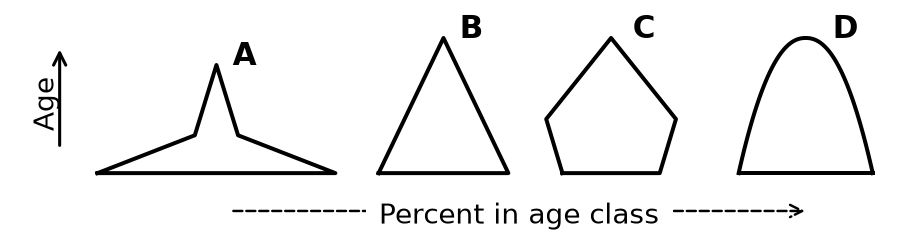
Consider the four age pyramids given below namely A, B, C and D representing four different countries.
Which one of them indicates the declining population?
Answer (c) & explanation
C is correct (c). Step 1: in an age pyramid, the bottom bars show children and the top bars show old people. Step 2: a wide bottom means many children are being born, so the population will grow. Pyramids A, B and D have this shape. Step 3: in C, the bottom is narrower than the middle: fewer children are being born than there are adults now. Fewer children today means fewer parents tomorrow, so the population will decline. So (a), (b) and (d) fail.
Tip: read a pyramid from the bottom up. A narrowing base is the sign of an ageing, shrinking population, as in Japan or Italy today.
Answer as per the official UPSC answer key.
Read the passage
A species that exerts an influence out of proportion to its abundance in an ecosystem is called a keystone species. The keystone species may influence both the species richness of communities and the flow of energy and materials through ecosystems. The sea star Pisaster ochraceus, which lives in rocky intertidal ecosystems on the Pacific coast of North America, is also an example of a keystone species. Its preferred prey is the mussel Mytilus californianus. In the absence of sea stars, these mussels crowd out other competitors in a broad belt of the intertidal zone. By consuming mussels, sea star creates bare spaces that are taken over by a variety of other species.
A study at the University of Washington demonstrated the influence of Pisaster on species richness by removing sea stars from selected parts of the intertidal zone repeatedly over a period of five years. Two major changes occurred in the areas from which sea stars were removed. First, the lower edge of the mussel bed extended farther down into the intertidal zone, showing that sea stars are able to eliminate mussels completely where they are covered with water most of the time. Second, and more dramatically, 28 species of animals and algae disappeared from the sea star removal zone. Eventually only Mytilus, the dominant competitor, occupied the entire substratum. Through its effect on competitive relationships, predation by Pisaster largely determines which species live in these rocky intertidal ecosystems.
What is the crux of the passage ?
Answer (c) & explanation
Keystone species ensures species diversity is correct (c). Step 1: the passage says a keystone species influences 'species richness'. Step 2: when sea stars were removed, 28 species of animals and algae disappeared, and only the mussel took over. So the keystone predator keeps many species alive: (c). Step 3: (a) is a detail, the sea star's preferred prey. (b) reverses the relation. (d) is wrong: the passage says the sea star is 'also an example', so it is not the only one. So (a), (b) and (d) fail.
Tip: the crux is the general idea that the example proves. Here the sea star story proves the keystone idea.
Answer as per the official UPSC answer key.
You are an officer in-charge for providing basic medical facilities to the survivors of an earthquake affected area. Despite your best possible effort, people put allegations against you for making money out of the funds given for relief. You would
Answer (a) & explanation
UPSC's key lists (a) and (c), with no negative marking; (a) is the best response. Step 1: you are working hard on earthquake relief, but people allege you are misusing funds. Step 2: (a) letting an enquiry be set up shows transparency and clears your name through a fair process. (c) not being distracted lets the relief work continue for survivors. Step 3: (b) asking to be replaced and (d) stopping work both hurt the survivors who need help now.
Tip: for these interpersonal items, pick the response that is lawful, honest and keeps the public work going. Avoid options that give in to pressure, pass the buck or abandon duty.
Answer as per the official UPSC answer key.
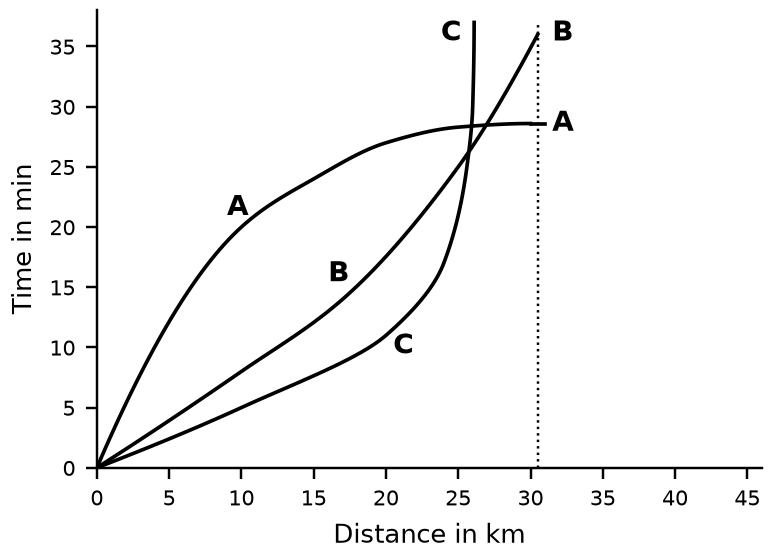
Consider the following distance-time graph. The graph shows three athletes A, B, and C running side by side for a 30 km race.
With reference to the above graph, consider the following statements:
- 1. The race was won by A.
- 2. B was ahead of A up to 25 km mark.
- 3. C ran very slowly from the beginning.
Which of the statements given above is/are correct?
Answer (b) & explanation
1. Here time is on the up-down axis, so a lower line means less time taken for the same distance (faster).
2. At 30 km, A's line is lowest (about 28 min); B takes about 35 min and C never reaches 30 km. A wins: 1 is correct.
3. Up to about 25 km, B's line is below A's, so B reached each mark sooner: 2 is correct.
4. At the start C's line is the lowest of all, so C was the fastest early on: 3 is wrong.
5. Answer: 1 and 2 only.
Answer as per the official UPSC answer key.
Read the passage
Now India’s children have a right to receive at least eight years of education, the gnawing question is whether it will remain on paper or become a reality. One hardly needs a reminder that this right is different from the others enshrined in the Constitution, that the beneficiary – a six year old child cannot demand it, nor can she or he fight a legal battle when the right is denied or violated. In all cases, it is the adult society which must act on behalf of the child. In another peculiarity, where a child’s right to education is denied, no compensation offered later can be adequate or relevant. This is so because childhood does not last. If a legal battle fought on behalf of a child is eventually won, it may be of little use to the boy or girl because the opportunity missed at school during childhood cannot serve the same purpose later in life. This may be painfully true for girls because our society permits them only a short childhood, if at all. The Right to Education (RTE) has become law at a point in India’s history when the ghastly practice of female infanticide has resurfaced in the form of foeticide. This is “symptomatic of a deeper turmoil” in society which is compounding the traditional obstacles to the education of girls. Tenacious prejudice against the intellectual potential of girls runs across our cultural diversity and the system of education has not been able to address it.
Which one of the following statements conveys the key message of the passage ?
Answer (c) & explanation
Option (c) is the key message. Step 1: the passage says a child cannot demand the right or fight for it, so adults must act. Step 2: it says a lost childhood cannot be compensated later, and that this is 'painfully true for girls', who face foeticide and prejudice. Step 3: all of this adds up to one message: the right to education, especially for girls, must be safeguarded: (c). (a) is only background. (b) is not stated; the passage says adults must act, not that they are unwilling. (d) is vague and misses the girl-child focus.
Tip: the key message ties together all the main points. Here: children cannot defend the right, loss cannot be undone, girls suffer most.
Answer as per the official UPSC answer key.
Read the passage
For achieving inclusive growth there is a critical need to rethink the role of the State. The early debate among economists about the size of the Government can be misleading. The need of the hour is to have an enabling Government. India is too large and complex a nation for the State to be able to deliver all that is needed. Asking the Government to produce all the essential goods, create all the necessary jobs, and keep a curb on the prices of all goods is to lead to a large cumbersome bureaucracy and widespread corruption.
The aim must be to stay with the objective of inclusive growth that was laid down by the founding fathers of the nation and also to take a more modern view of what the State can realistically deliver.
This is what leads to the idea of an enabling State, that is, a Government that does not try to directly deliver to the citizens everything that they need. Instead, it (1) creates an enabling ethos for the market so that individual enterprise can flourish and citizens can, for the most part, provide for the needs of one another, and (2) steps in to help those who do not manage to do well for themselves, for there will always be individuals, no matter what the system, who need support and help. Hence we need a Government that, when it comes to the market, sets effective, incentive-compatible rules and remains on the sidelines with minimal interference, and, at the same time, plays an important role in directly helping the poor by ensuring that they get basic education and health services and receive adequate nutrition and food.
According to the passage, the strategy of inclusive growth can be effected by focussing on
Answer (d) & explanation
Delivery of basic services to the deprived is correct (d). Step 1: find what the State should do for the poor. The passage says it should play 'an important role in directly helping the poor' by ensuring basic education and health services and adequate nutrition and food. That is option (d). Step 2: check (a). The passage says India is too large for the State to 'deliver all that is needed', so 'all the needs of every citizen' is wrong. Step 3: check (b) and (c). More regulation and controlling distribution are what the passage rejects; it wants minimal interference in markets. So (a), (b) and (c) fail.
Tip: options that sound generous ('all needs') are often the trap. Match the option to the passage's exact list of services.
Answer as per the official UPSC answer key.
There are four routes to travel from city A to city B and six routes from city B to city C. How many routes are possible to travel from the city A to city C?
Answer (a) & explanation
24 routes is correct (a). Step 1: there are 4 routes from A to B. Step 2: for each of those, there are 6 routes from B to C. Step 3: so the total number of A-to-C routes is 4 × 6 = 24. Adding them (4 + 6 = 10) would be wrong, because every first route pairs with every second route. So (b), (c) and (d) fail.
Tip: this is the multiplication rule of counting. When one choice is followed by another, multiply the number of ways. Add only when you choose one path or another, not one then another.
Answer as per the official UPSC answer key.
Read the passage
He walked several miles that day but could not get anything to eat or drink except some dry bread and some water, which he got from cottagers and farmers. As night fell, he slept under a haystack lying in a meadow. He felt frightened at first, for the wind blew awfully over the empty fields. He felt cold and hungry, and was feeling more lonely than he had ever felt before. He, however, soon fell asleep, being much tired with his long walk. When he got up next day, he was feeling terribly hungry so he purchased a loaf of bread with a few coins that he had.
With reference to the passage, consider the following statements :
- 1. He was walking through the countryside.
- 2. The cottagers and farmers gave him enough food so that he could sleep at night without feeling hungry.
Which of the statements given above is/are correct ?
Answer (a) & explanation
Statement 1 only is correct (a). Step 1: the passage mentions cottagers, farmers, a haystack, a meadow and empty fields. These place him in the countryside: statement 1. Step 2: statement 2 is wrong: he got only 'dry bread and some water', and at night he 'felt cold and hungry'. So he did not get enough food to sleep without hunger. Step 3: options (b), (c) and (d) fail.
Tip: test each statement against a specific line. Statement 2 is directly contradicted by 'felt cold and hungry'.
Answer as per the official UPSC answer key.
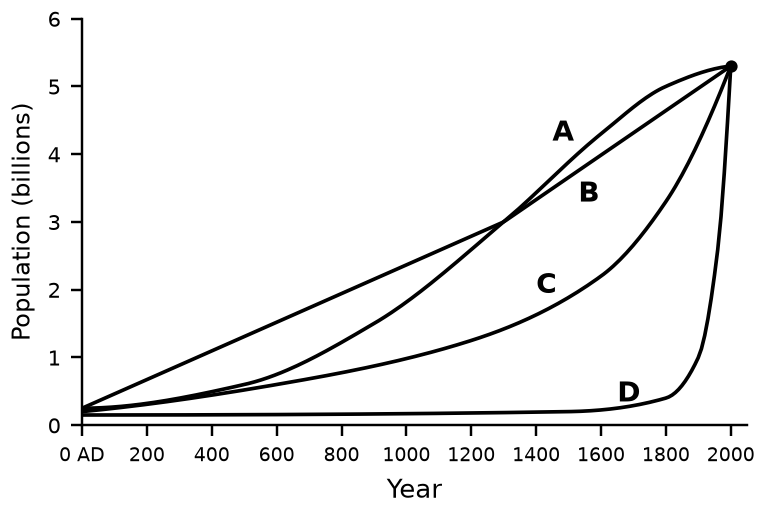
The following figure has four curves namely A, B, C and D. Study the figure and answer the item that follows.
Which curve indicates the exponential growth?
Answer (c) & explanation
C is correct (c). Step 1: exponential growth means the quantity grows by the same percentage each period, so the curve rises slowly at first and then faster and faster. Step 2: check the curves. B is a straight line, which shows steady (linear) growth. A rises but bends over and flattens at the top, which shows growth slowing to a limit. Step 3: C keeps bending upward, getting steeper each period. That is the exponential shape. So (a), (b) and (d) fail.
Tip: straight line = constant addition; upward curve = constant multiplication; S-shaped or flattening curve = growth hitting a limit.
Many readers pick D because it looks like the sharp J-shaped curve; the official answer is (c), as printed.
Answer as per the official UPSC answer key.
Read the passage
A species that exerts an influence out of proportion to its abundance in an ecosystem is called a keystone species. The keystone species may influence both the species richness of communities and the flow of energy and materials through ecosystems. The sea star Pisaster ochraceus, which lives in rocky intertidal ecosystems on the Pacific coast of North America, is also an example of a keystone species. Its preferred prey is the mussel Mytilus californianus. In the absence of sea stars, these mussels crowd out other competitors in a broad belt of the intertidal zone. By consuming mussels, sea star creates bare spaces that are taken over by a variety of other species.
A study at the University of Washington demonstrated the influence of Pisaster on species richness by removing sea stars from selected parts of the intertidal zone repeatedly over a period of five years. Two major changes occurred in the areas from which sea stars were removed. First, the lower edge of the mussel bed extended farther down into the intertidal zone, showing that sea stars are able to eliminate mussels completely where they are covered with water most of the time. Second, and more dramatically, 28 species of animals and algae disappeared from the sea star removal zone. Eventually only Mytilus, the dominant competitor, occupied the entire substratum. Through its effect on competitive relationships, predation by Pisaster largely determines which species live in these rocky intertidal ecosystems.
With reference to the passage, consider the following statements :
- 1. Mussels are generally the dominant species in intertidal ecosystems.
- 2. The survival of sea stars is generally determined by the abundance of mussels.
Which of the statements given above is/are correct ?
Answer (d) & explanation
Neither statement is correct (d). Step 1: statement 1 says mussels are generally dominant. The passage says they crowd out others only 'in the absence of sea stars'. So they are not generally dominant: 1 is wrong. Step 2: statement 2 says sea-star survival depends on mussels. The passage shows the reverse: sea stars control mussels, not mussels controlling sea stars. So 2 is wrong. Step 3: options (a), (b) and (c) fail.
Tip: watch for conditions. 'In the absence of X' cannot become 'generally'. Also check the direction of cause and effect.
Answer as per the official UPSC answer key.